As a Senior Expedition for A1 Excursion Adventure, I have spent decades navigating the intricate trails of the Himalayas here in Nepal. Over the years, I have guided countless trekkers through the lush, emerald valleys of the Annapurna massif and across the arid, wind-scoured plains of the "Forbidden Kingdom" of Mustang.
When clients sit down at our Kathmandu office, the most common question I hear is: "Which is better? The Upper Mustang vs. the Annapurna Trek?" The truth is, comparing the Annapurna Circuit vs Upper Mustang trek is like comparing two entirely different planets that happen to share the same mountain range. They offer opposed experiences, challenging you in different ways and rewarding you with entirely distinct memories.
The Annapurna region is famous for offering "Five Treks in One," an ecological marvel where you transition from subtropical banana plantations and terraced rice paddies to alpine meadows and glaciated alpine passes. It is a journey through a vibrant, shifting biosphere. On the other hand, the Upper Mustang region is a "Martian, red desert" landscape. It is a stark, hauntingly beautiful Trans-Himalayan desert hidden deep within the Himalayan rain shadow.
Choosing between these two legendary routes requires an understanding of your physical capabilities, your cultural interests, the time of year you plan to travel, and your budget. In this definitive guide, I will break down every aspect of these two treks to help you decide which adventure is your ultimate Himalayan calling.
Table of Contents
Annapurna vs Upper Mustang Region Difficulty
While both treks require a solid fitness level, the nature of the physical challenge varies drastically between the two regions.
How Difficult is the Annapurna Trek?
Whether you are tackling the full Annapurna Circuit or the journey to Annapurna Base Camp (4,130 m), the primary physical obstacle is extreme altitude and dramatic elevation changes. The Annapurna Circuit demands remarkable endurance as trekkers prepare to cross the formidable Thorong La Pass, which sits at a staggering 5,416 meters (17,769 feet). Climbing to this altitude means operating in air that contains roughly half the oxygen found at sea level. The ascent requires days of careful acclimatization, patience, and mental resilience. As you climb higher, the air grows thinner, temperatures drop well below freezing, and every step requires focused effort.
Furthermore, what goes up must come down. The descents in the Annapurna region are notoriously long and demanding on the knees. The trek down from Thorong La Pass toward the sacred Muktinath Temple drops over 1,600 meters in a single day, traversing steep scree slopes and rocky pathways. Along the route, trekkers are rewarded with cultural and scenic highlights such as Marpha Village, a charming settlement famous for its traditional whitewashed houses, apple orchards, and locally produced apple brandy. Marpha provides a welcome opportunity to rest, explore the rich Thakali culture, and enjoy fresh bakery items and warm hospitality after challenging trekking days.
Similarly, the ABC trek is renowned for its relentless stone staircases, demanding significant quadriceps and calf strength, making physical preparation essential for a safe and enjoyable journey.
Is Upper Mustang Trek Easier or Harder?
In contrast, the Upper Mustang trek is often characterized as "Moderate but Rugged." Unlike the Annapurna Circuit, there are no massive, oxygen-starved passes pushing you to 5,000+ meters. The average trekking altitude in the Upper Mustang region hovers between 3,500 and 4,200 meters. However, do not mistake "moderate altitude" for an easy walk. The challenge in Mustang comes from the raw, exposed environment. You will be embarking on daily treks of 15 kilometers or more across undulating, dusty terrain. The trails often follow the ancient, dried riverbeds of the Kali Gandaki Gorge, the deepest gorge in the world.
The most formidable adversary in Upper Mustang is not the altitude, but the wind. By late morning, powerful thermal dynamics funnel gale-force winds up the gorge from the south. Trekking against these relentless afternoon winds, wrapped in a buff and sunglasses to protect against flying sand and dust, requires a unique type of physical grit. It is a high-desert endurance test where hydration and sun protection are just as critical as your hiking boots.
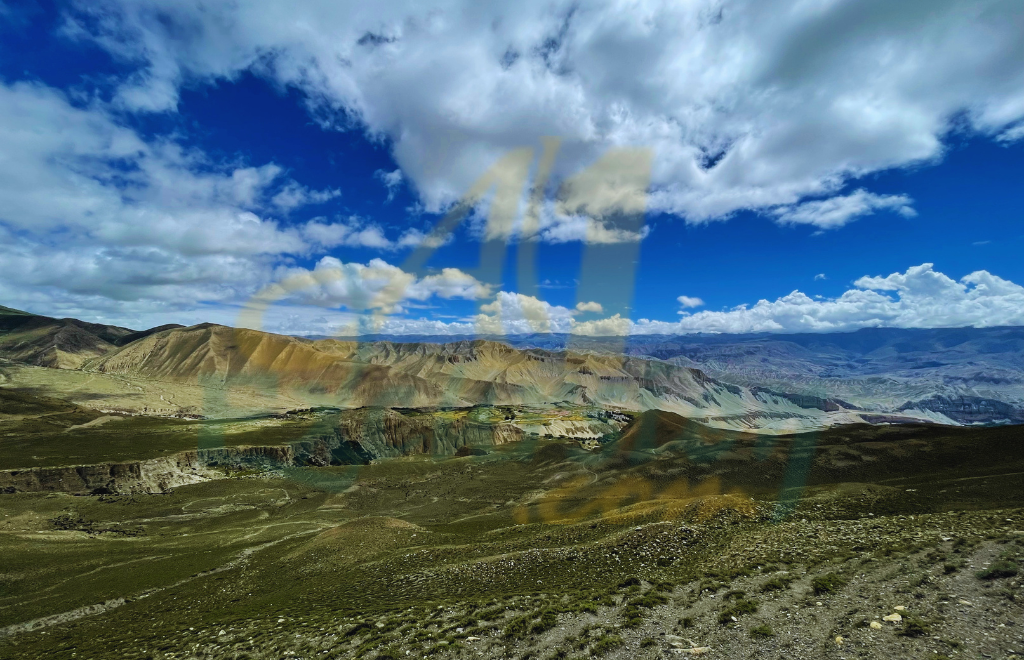
View of Amazing landscape in Upper Mustang region
Cultural Experience: Upper Mustang region vs Annapurna Trek
The Himalayas of the Annapurna and Mustang region are not just geological wonders; they are the ancestral homes of diverse ethnic groups here in Nepal. The cultural experience depends entirely on which side of the mountains you choose to walk.
Annapurna’s Cultural Diversity (Gurung, Magar, Hindu Traditions)
The Annapurna region is a vibrant "Melting Pot" of both Hindu and Buddhist cultures. Starting in the lower elevations, you will walk through vibrant Hindu villages inhabited by the Brahmin and Chhetri communities, marked by terraced farms and bustling local schools. As you climb higher, the cultural landscape shifts, and the legendary hospitality of the Gurung and Magar people welcomes you.
These ethnic groups, historically famous for their service in the Gurkha regiments, run the intricate network of teahouses that dot the trail. You will encounter a beautiful syncretism of religion here. A perfect example is the Muktinath temple, a sacred pilgrimage site revered equally by Hindus (who believe it to be a place of salvation) and Buddhists (who view it as a residence of Dakinis, goddesses known as Sky Dancers). The trail is heavily trafficked, meaning you will share the path with pilgrims, local traders, and trekkers from all over the globe, resulting in a lively, communal atmosphere.
Upper Mustang’s Tibetan Buddhist Heritage
If Annapurna is a melting pot, the Upper Mustang region is a "Time Capsule." Until 1992, this region was completely closed off to the outside world, preserving an extraordinary pocket of 8th-century Tibetan Buddhist culture that remains remarkably untouched by modern influence.
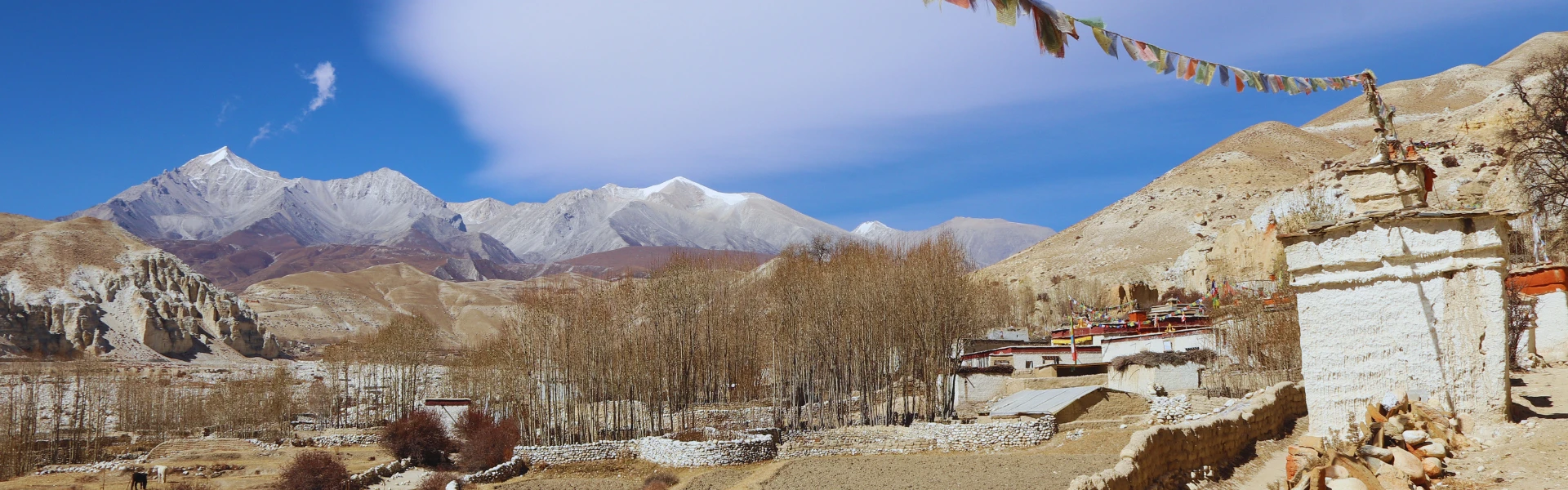
Trekking into Upper Mustang feels like walking through the pages of a lost history book. The architecture is defined by flat-roofed houses painted in stark white and ochre, adorned with stacked firewood, which indicates a family's wealth. The crown jewel of the trek is the walled city of Lo Manthang, the ancient capital of the Kingdom of Lo. Walking through its narrow alleys, you will encounter 14th-century monasteries like the spectacular Thupchen Gompa, currently undergoing meticulous restoration to preserve its towering, ancient murals and mandalas. Beyond the monasteries, the landscape itself holds archaeological mysteries: the ancient Sky Caves. Carved directly into the sheer, fragile cliffs hundreds of feet above the valley floor, these thousands of man-made caves were used variously as burial chambers, meditation retreats, and fortresses during times of conflict over the last two millennia. Engaging with the locals here is a quieter, more profound experience, steeped in ancient rituals, horse-riding traditions, and the chanting of resident monks.
Best Time to Trek: Upper Mustang region vs Annapurna Region
Choosing the best time to trek in Nepal is usually simple: Spring (March-May) or Autumn (September-November). But what if you can only travel during the summer months of June, July, or August? This is where the divergence between these two treks becomes most critical.
Best Seasons for Annapurna Trek (Spring & Autumn)
During the summer, the Indian Ocean sends heavy monsoon clouds sweeping across the subcontinent, smashing directly into the southern flanks of the Himalayas. The Annapurna massif takes the absolute brunt of this weather system. Trekking the Annapurna trails during the monsoon means walking through drenched, muddy forests. The views are frequently obscured by thick, persistent clouds, and the trails become incredibly slippery. Furthermore, the lush, wet vegetation becomes a breeding ground for leeches. While a summer trek in Annapurna offers blooming alpine flora and roaring waterfalls, the logistical and comfort challenges are immensely high.
Why the Upper Mustang region is the Best Monsoon Trek in Nepal
This brings us to the greatest geographic advantage of the "Forbidden Kingdom." Upper Mustang is universally recognized as the best monsoon trek Nepal has to offer.
Because Mustang lies geographically north of the towering Annapurna and Dhaulagiri mountain ranges, it sits entirely within the Himalayan rain shadow. The massive peaks to the south act as an impenetrable wall, blocking the monsoon clouds from reaching the Mustang plateau. While the rest of Nepal is battered by daily downpours, Upper Mustang remains incredibly dry, sunny, and leech-free. The skies are a brilliant, piercing blue, contrasting magnificently with the red and yellow rock formations. If you are planning a summer adventure, Upper Mustang is unequivocally the superior choice.
If you want more detailed information regarding permit costs, insurance requirements, and the latest trekking regulations, please read our full blog post here.
Annapurna Region and Upper Mustang Trek Permits & Rules
The administrative realities of these two treks are vastly different. Knowing the rules, especially regarding solo trekking in Nepal's restricted areas, is crucial for your planning.
Annapurna Permits (ACAP & TIMS Card)
The Annapurna region is classified as an open trekking area. To trek here, you simply need standard permits: the Annapurna Conservation Area Project (ACAP) permit and the Trekkers' Information Management System (TIMS) card. Combined, these permits cost approximately $50 USD. The process is straightforward, the fees are low, and the area is highly accessible to a large volume of trekkers.
Upper Mustang trek Restricted Area Permit (RAP)
Because Upper Mustang is a culturally and ecologically sensitive zone bordering Tibet, the Nepalese government designates it as a Restricted Area. The Mustang trekking permit cost reflects this exclusivity. To enter, foreigners must obtain a Restricted Area Permit (RAP), which has been priced at $50 USD per person, per day since the updated regulations were implemented in March 2026.
While you can now apply as a solo traveler, hiring a licensed trekking guide remains strictly mandatory. Independent trekking without a guide is not permitted. Due to the remote nature of the region, the latest standard requirements also dictate that proof of comprehensive travel insurance is a prerequisite for issuing Mustang permits. Your policy must explicitly cover emergency helicopter rescue and medical evacuation at high altitudes (specifically stating coverage for at least 4,000 meters). Without this documentation, your permit application will be denied.
If you want more detailed information regarding permit costs, insurance requirements, and the latest trekking regulations, please read our full blog post here.
To make your decision easier, here is a quick-reference breakdown of the two treks:
Feature
Annapurna Trek (Circuit/Base Camp)
Upper Mustang Trek
Landscape
"Five Treks in One": Jungles, terraced fields, alpine meadows, glaciers.
Trans-Himalayan desert: Barren, red-rock canyons, ancient riverbeds.
Max Altitude
5,416m (Thorong La Pass) or 4,130m (Annapurna Base Camp).
4,200m (Marang La Pass) - Moderate but exposed.
Culture
"Melting Pot": Hindu & Buddhist, vibrant Gurung and Magar villages.
"Time Capsule": 8th-century Tibetan Buddhism, Lo Manthang walled city.
Crowds
High traffic, highly social, bustling teahouses.
Very low traffic, quiet, exclusive, and intimate.
Permit Cost
~$50 USD (ACAP + TIMS).
$50 USD per day (RAP)
Best Season
Spring (March-May) & Autumn (Sept-Nov).
Summer (June-August) & Autumn (Sept-Nov).
Guide Rules
Guide highly recommended, required by standard national mandates.
Strictly Mandatory: Must be accompanied by a licensed guide.
Can you combine the Upper Mustang Region and the Annapurna Trek?
As a Senior Expedition Strategist, my absolute favorite itinerary refuses to choose between the two. If you have the time, the budget, and the stamina, I highly recommend our 20–25 day Annapurna-Mustang Combo Trek. This epic journey begins in the lush foothills of Besisahar, then takes you up the classic Annapurna Circuit through Manaslu. You will push your physical limits to cross the breathtaking Thorong La Pass 5416m, experiencing the ultimate high-altitude triumph. Then, as you descend to the sacred Muktinath temple and reach the wind-swept town of Kagbeni, instead of heading south to finish the circuit, you turn North.
Leaving the crowds behind, you enter the restricted gates of Upper Mustang, transitioning from the alpine ice of Annapurna into the red-desert canyons of the Forbidden Kingdom. You will trek up to the walled city of Lo Manthang, explore the ancient caves, and finally descend via the Kali Gandaki Gorge to Jomsom.
Annapurna Trek and Upper Mustang Trekking Packages
Whether you are seeking the high-altitude thrills of the Annapurna Circuit or exploring exclusive Lo Manthang tour packages, undertaking these expeditions requires flawless logistics. At A1 Excursion Adventure, our team comprises experts with extensive regional experience, ensuring your journey is safe, culturally enriching, and unforgettable.
Our Popular Upper Mustang Packages
Explore the "Forbidden Kingdom" with itineraries designed for deep cultural immersion and breathtaking desert landscapes.
Annapurna Trek vs Upper Mustang Trek: Which Trek is Better for You?
Between an Upper Mustang vs. an Annapurna Trek, your choice ultimately comes down to what kind of experience you are seeking from the Himalayas. Neither is "better," but they are worlds apart.
Choose the Annapurna Trek if you want the "High Himalaya" adventure, moving from lush rhododendron forests and terraced fields to the physical achievement of crossing the Thorong La Pass (5,416m). It is the ideal choice for those on a budget who want diverse ecosystems and the social atmosphere of well-developed teahouses.
Choose the Upper Mustang Trek if you seek a cultural "time capsule" and the stark, "Martian" beauty of a high-altitude desert. It is the premier choice for travelers during the Monsoon (June–August), as it stays dry in the rain shadow. It is perfect for those who prioritize ancient history, the mystery of Sky Caves, and the medieval isolation of the walled city of Lo Manthang.
For the ultimate adventurer with ample time, we recommend the Combo Trek, which merges these two worlds into one seamless expedition. Both Annapurna and Upper Mustang will change the way you see the world. The only question left is: which path will you take? Contact A1 Excursion Adventure today to begin your Adventure here in Nepal.
FAQs
Which trek is harder: Annapurna or Upper Mustang?
The Annapurna Trek is generally harder due to extreme altitude, especially when crossing Thorong La Pass (5,416m). Upper Mustang, while still physically demanding, stays at lower altitudes (around 3,500–4,200m) and is considered moderately difficult.
Is the Upper Mustang Trek worth the high cost?
Yes, the Upper Mustang Trek is worth the cost if you value unique cultural experiences and remote landscapes. The restricted area permit ensures fewer crowds and access to preserved Tibetan Buddhist heritage, including the ancient walled city of Lo Manthang.
Can I trek the Upper Mustang solo?
No, solo trekking is not allowed in Upper Mustang. It is a restricted area, and you must be accompanied by a licensed guide and travel through a registered trekking agency.
Which trek is better during the monsoon season?
Upper Mustang is the best choice during the monsoon (June–August) because it lies in the Himalayan rain shadow and remains dry. Annapurna trails receive heavy rainfall, making them muddy and less enjoyable during this time.
How many days are needed for the Upper Mustang vs. the Annapurna Trek?
The Upper Mustang Trek typically takes 12–14 days, while the Annapurna Circuit takes around 14–20 days. Shorter options like Annapurna Base Camp can be completed in 7–12 days.
Do I need travel insurance for these treks?
Yes, travel insurance is highly recommended for both treks and mandatory for Upper Mustang permits. Your policy should cover high-altitude trekking (at least 4,000 meters) and emergency helicopter evacuation.
Raj Thapa
Founder & Managing Director Raj Kumar Thapa: Founder & Managing Director of the Company, and has over 2 decades of professional experience in the travel and trekking field. Mr. Raj has spent the entirety of his career in the travel & trek organization.


.webp)