Every year, as the monsoon begins to retreat from the Kathmandu Valley, the historic heart of Kathmandu comes alive with drums, masked dancers, chariots, oil lamps, ancient rituals, and enormous crowds. This is Indra Jatra, locally known as Yenya, one of Nepal's most spectacular traditional festivals.
For eight days, the old city of Kathmandu becomes a living cultural stage. Narrow streets around Kathmandu Durbar Square fill with processions, religious performances, and masked dances. The towering chariot of the Living Goddess Kumari moves through historic neighbourhoods, while Lakhe dancers, Pulukisi, Bhairav masks, and traditional musicians transform the ancient city into a celebration unlike any other. But Indra Jatra is much more than a colourful street festival. Behind the music and celebrations lies a collection of stories about gods, ancestors, rain, agriculture, death, protection, and the relationship between the human world and the divine. At the centre of one of its best-known legends is Indra, the king of heaven, who descended into Kathmandu disguised as an ordinary human while searching for Parijat, the night jasmine flower.
The story explains why the god of heaven was once captured by the people of Kathmandu and why his captivity is still symbolically remembered during the festival. Indra Jatra also brings together Hindu and Buddhist traditions, Newar culture, living deities, ancient city rituals, and community traditions that have survived for centuries.
For travellers visiting Nepal, it is one of the most fascinating times to experience Kathmandu.
Table of Contents
What Is Indra Jatra?
Indra Jatra is an eight-day festival traditionally celebrated by the Newar community of the Kathmandu Valley. Known as Yenya in Nepal Bhasa, the festival is deeply connected to Kathmandu's cultural, religious, and historical traditions.
The festival begins with the ceremonial erection of a wooden pole, known as Yosin, in Basantapur Square, in front of the historic Hanuman Dhoka Palace. This marks the official beginning of Indra Jatra and sets the stage for days of processions, rituals, music and traditional performances. One of the festival's most significant figures is the Living Goddess Kumari, whose chariot procession is one of the major highlights of the celebrations. Indra Jatra also features colourful chariot processions, masked dances, traditional music, religious performances, ceremonial displays and illuminated streets, bringing the historic centre of Kathmandu to life.
The celebrations take place around the historic heart of the city, particularly Kathmandu Durbar Square, Basantapur, Hanuman Dhoka, Indra Chowk, Maru, Asan and the surrounding old neighbourhoods. The festival is celebrated through a combination of Hindu and Buddhist traditions and reflects the rich cultural heritage of the Kathmandu Valley. It also marks the beginning of Kathmandu's autumn festival season, when the city's historic streets and courtyards become centres of community gatherings, religious rituals and cultural celebrations.
Indra Jatra Date:
In 2026, Indra Jatra is observed from September 23 to September 30, according to the festival information supplied for this article.
The Legend Behind Indra Jatra
The most famous story behind Indra Jatra begins with a flower. The flower is Parijat, the night jasmine. According to the traditional legend, Indra, the Lord of Heaven, came down from heaven to Kathmandu disguised as an ordinary person. He was looking for Parijat flowers because his mother needed them for a religious observance. Because Indra had hidden his identity, nobody in Kathmandu recognised him as a god. Instead, people saw an unfamiliar man gathering flowers. They assumed he was stealing them. Indra was caught and tied up like a common thief. The story becomes even more interesting when Indra's celestial elephant begins searching Kathmandu's streets for its missing master.
Indra's mother eventually comes down from heaven as well. When she reveals their identities, the people realise that the man they have captured is not an ordinary flower thief but the king of heaven himself. The people are relieved and embarrassed. They celebrate the extraordinary event with food, music, dancing and processions. Before leaving Kathmandu, however, Indra's mother grants the people a series of blessings. One of these is connected with the souls of people who have died during the year. The legend says that the deceased would follow Indra's mother towards heaven by forming a human chain, holding onto one another and eventually gripping her sari. The chain, however, breaks during the journey. The souls fall into a lake on a mountain south of Kathmandu. This story became closely connected with rituals for the deceased during Indra Jatra.
Another important blessing is associated with the gentle morning mist that arrives in the Kathmandu Valley after the monsoon. Traditionally, this mist is understood as a divine gift that helps ripen the autumn harvest. The story therefore connects Indra Jatra not only to mythology but also to rain, agriculture, death and the seasonal cycle. Nepali Times describes the Parijat story as one of the festival's central legends, while also noting deeper interpretations tied to the agricultural civilisation of the Kathmandu Valley.
Why Is Indra Jatra Celebrated?
Indra Jatra carries several layers of meaning. At one level, it commemorates the story of Lord Indra and his visit to Kathmandu. At another, it is connected with the end of the monsoon and gratitude for rain. For an agricultural society, rain was essential for survival. The Kathmandu Valley depended heavily on seasonal rainfall for farming, particularly rice cultivation. The festival therefore became associated with gratitude for the rains that supported the year's crops.
This agricultural interpretation is particularly important because the festival occurs as the monsoon season comes to an end. Indra Jatra can also be understood as a festival of ancestors. Families who have lost relatives during the previous year participate in rituals and processions remembering the dead. This creates an emotional contrast within the festival. The streets are full of music, dancing and celebration, yet there are also solemn processions dedicated to deceased family members. The festival therefore brings together life and death, celebration and remembrance.
The Yosin Pole: How Indra Jatra Begins
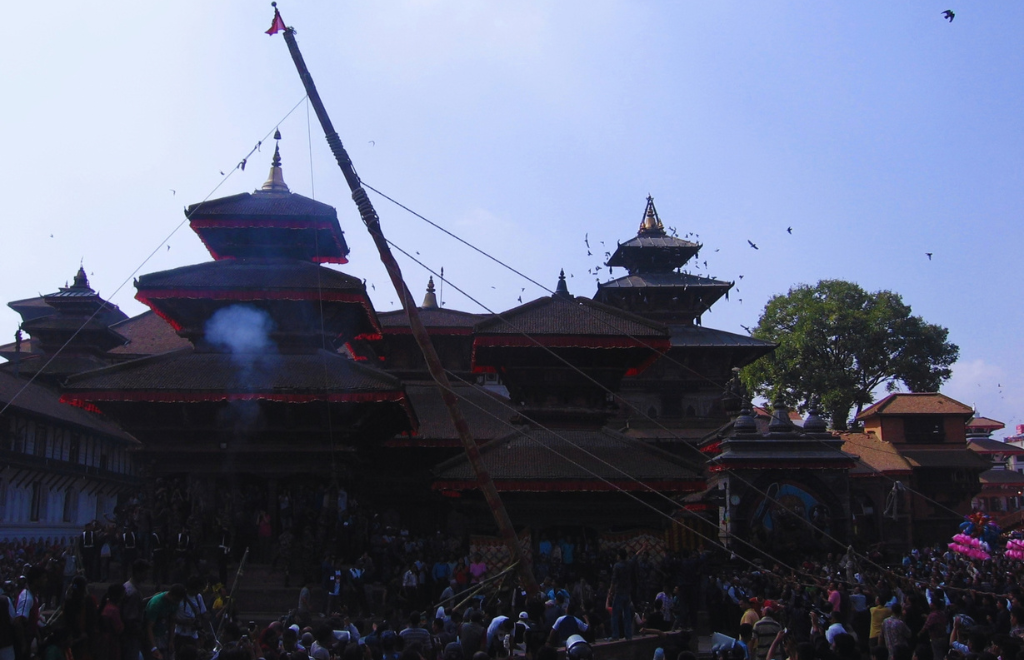
The raising of the Yosin (ceremonial wooden pole) at Basantapur Square, which officially kicks off Indra Jatra.
One of the most dramatic rituals of Indra Jatra is the raising of the Yosin, also known as the Indradhwaja. A large pine pole is ceremonially erected at Basantapur, in front of the historic Hanuman Dhoka Palace. The pole carries Indra's flag and symbolically announces the arrival of the festival. The process of bringing the pole into Kathmandu is itself part of the ritual.
According to traditional accounts, a specially selected tree is brought from the forest and transported towards Kathmandu through a ceremonial process involving different communities. The final raising of the pole attracts large crowds around Basantapur. When the pole stands upright, the festival has officially entered its most visible phase.
The Nepal Tourism Board describes the erection of the pine pole in Basantapur Square as the beginning of the eight-day festival. The pole remains an important symbol throughout Indra Jatra. It represents the presence of Indra in Kathmandu and connects the physical city with the mythology of heaven and earth.
Upaku Wanegu: Remembering the Dead
While many visitors come to see the chariots and masked dances, one of the most meaningful parts of Indra Jatra is the tradition of Upaku Wanegu. Families who have lost loved ones during the previous year participate in a procession around the old city. People carry lamps and remember their deceased relatives. The ritual is connected to the ancient story of Indra's mother and the souls of the dead. This part of Indra Jatra reminds us that the festival is not only about entertainment. It is also about memory, grief, and the continuing relationship between families and their ancestors.
The contrast is striking. In one part of the city, people may be watching a spectacular masked dance. Elsewhere, families are quietly walking through the old streets carrying lights for loved ones who have passed away. Both experiences are part of Yenya.
Majipa Lakhe: The Famous Masked Dancer
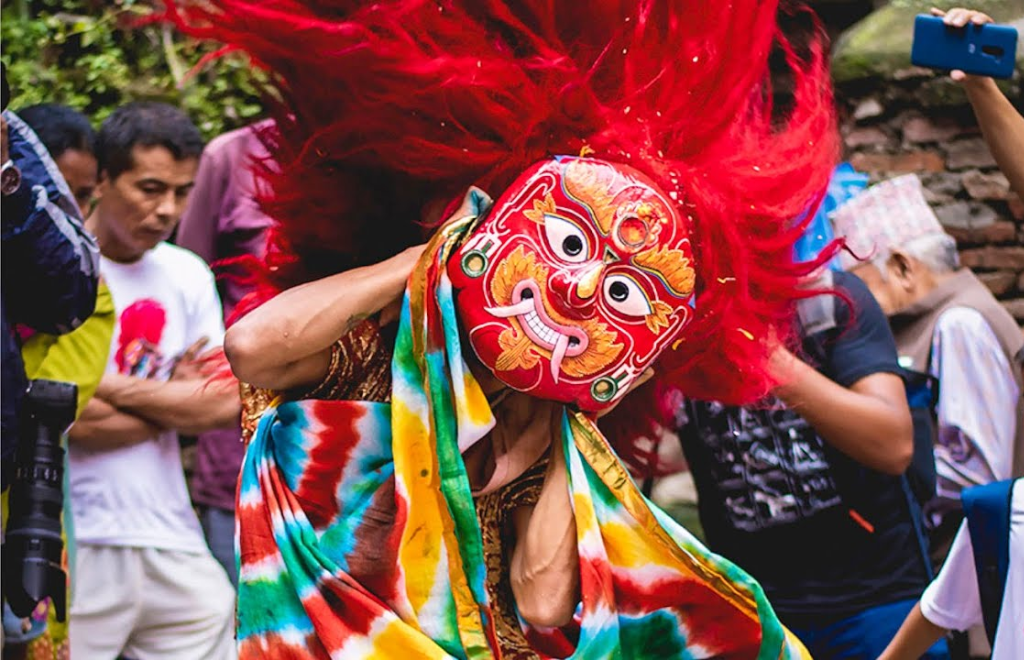
Few characters are more visually striking during Indra Jatra than Majipa Lakhe. The Lakhe is a frightening masked figure with a large red face, sharp teeth, and wild hair. Accompanied by powerful traditional drums, the Lakhe dances through the streets and attracts large crowds. Although the character may look frightening, Lakhe is traditionally understood as a protective figure. The energetic dance adds another dimension to Indra Jatra because the festival is not performed only inside temples.
The streets themselves become the stage. The sound of drums can travel through the narrow alleys of the old city while crowds suddenly make space for masked performers. For photographers and visitors experiencing Indra Jatra for the first time, the Lakhe dance is one of the festival's most memorable sights.
Pulukisi: The Elephant Searching for Indra
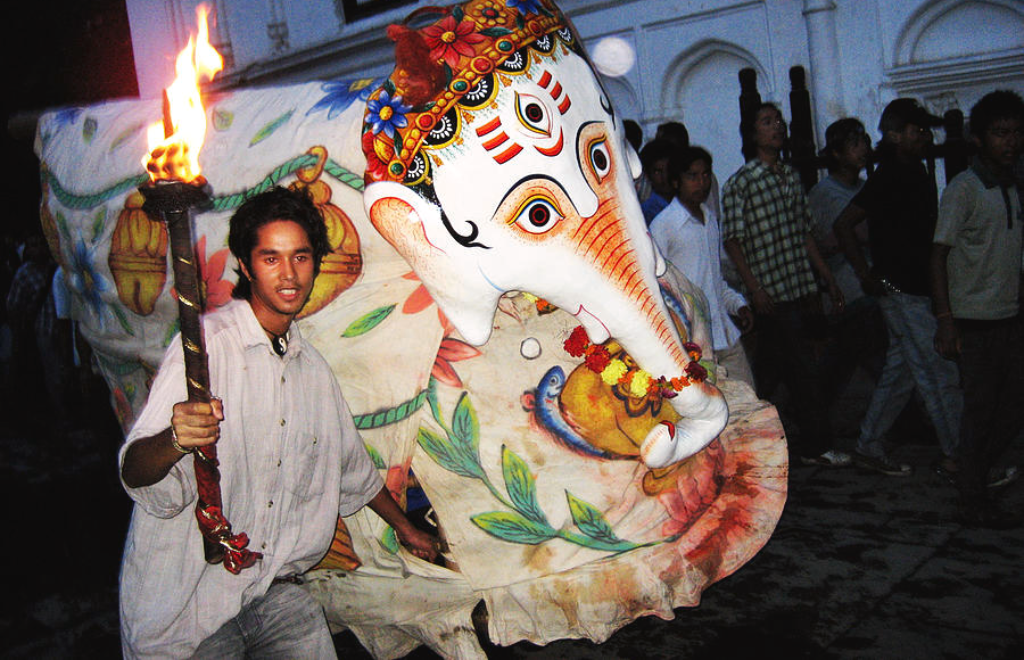
Pulukisi, the mythical white elephant of Lord Indra searching for the Missing King of heaven ( Indra).
Another unforgettable character is Pulukisi. Pulukisi represents Indra's white elephant, who comes down to earth searching for his missing master. The character is created using a bamboo and cloth structure, with performers inside. As the elephant moves through the narrow streets, it rushes and swings its trunk while people make way. Pulukisi transforms the ancient legend into a lively street performance. The connection is simple but powerful. Indra has been captured. His elephant is looking for him. The streets of Kathmandu become the setting for that search. It is one of the clearest examples of how mythology is preserved through performance during Indra Jatra.
Akash Bhairav and the Flow of Ayla
Another major attraction is the display of the enormous Akash Bhairav mask at Indra Chowk. During the festival, the giant mask is publicly displayed and becomes a major focus of worship and celebration. Traditional Newari drinks are associated with the ritual, and crowds gather around the shrine. The sight of the enormous Bhairav face above the busy streets is one of the defining visual experiences of Indra Jatra. The festival also features the public display of Seto Bhairav, or White Bhairav, at the historic palace area of Basantapur. These masks demonstrate another important characteristic of Kathmandu's festival culture. Sacred images that may remain hidden or inaccessible for much of the year can become publicly visible during specific festival periods.
The Nepal Tourism Board specifically notes the annual public display of Akash Bhairav during Indra Jatra and the opening of Swet Bhairav at Kathmandu Durbar Square during the festival period.
The Connection Between Indra Jatra and Kumari Jatra
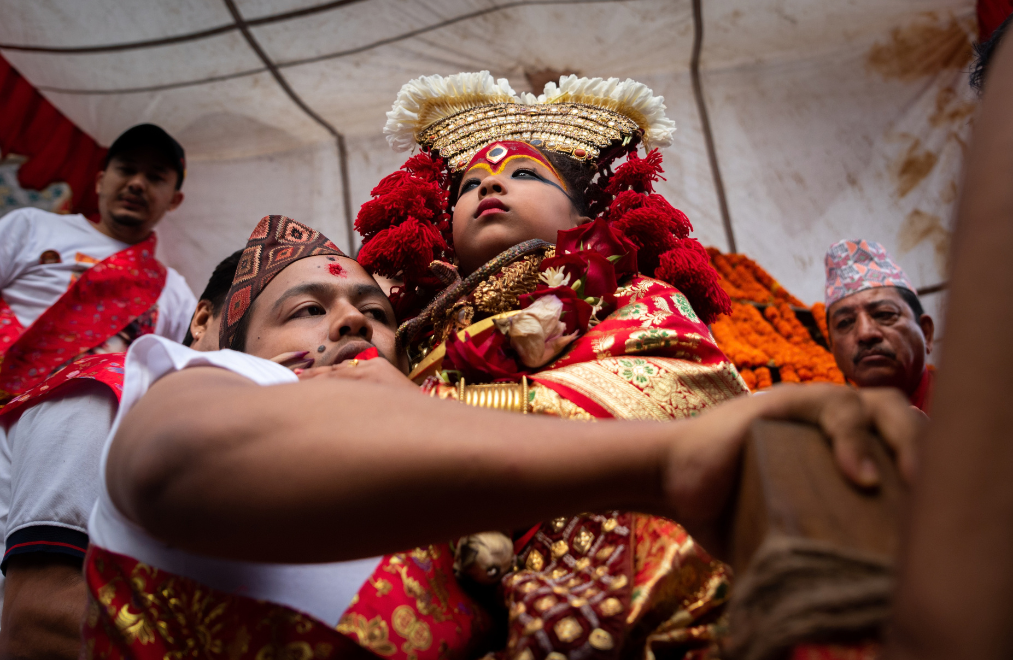
One of the most recognisable features of Indra Jatra is the procession of the Living Goddess Kumari. The Kumari is a young Newar girl traditionally revered as the living embodiment of the goddess Taleju. During Indra Jatra, the Kumari is carried through Kathmandu in a magnificent wooden chariot. Two smaller chariots carrying representations of Ganesh and Bhairav accompany her. The combination of Indra Jatra and Kumari Jatra has made the festival one of the most visually powerful celebrations in Kathmandu. The Nepal Tourism Board identifies the Kumari chariot procession as one of the major attractions of the festival.b The Kumari tradition also demonstrates the remarkable interaction between Hindu and Buddhist traditions in Kathmandu. The Kumari is traditionally selected from the Newar Buddhist Shakya community, while she is also deeply revered within Kathmandu's Hindu religious traditions. This intersection of traditions is one of the defining characteristics of Kathmandu Valley's cultural heritage.
Kumari Jatra: The Living Goddess Procession
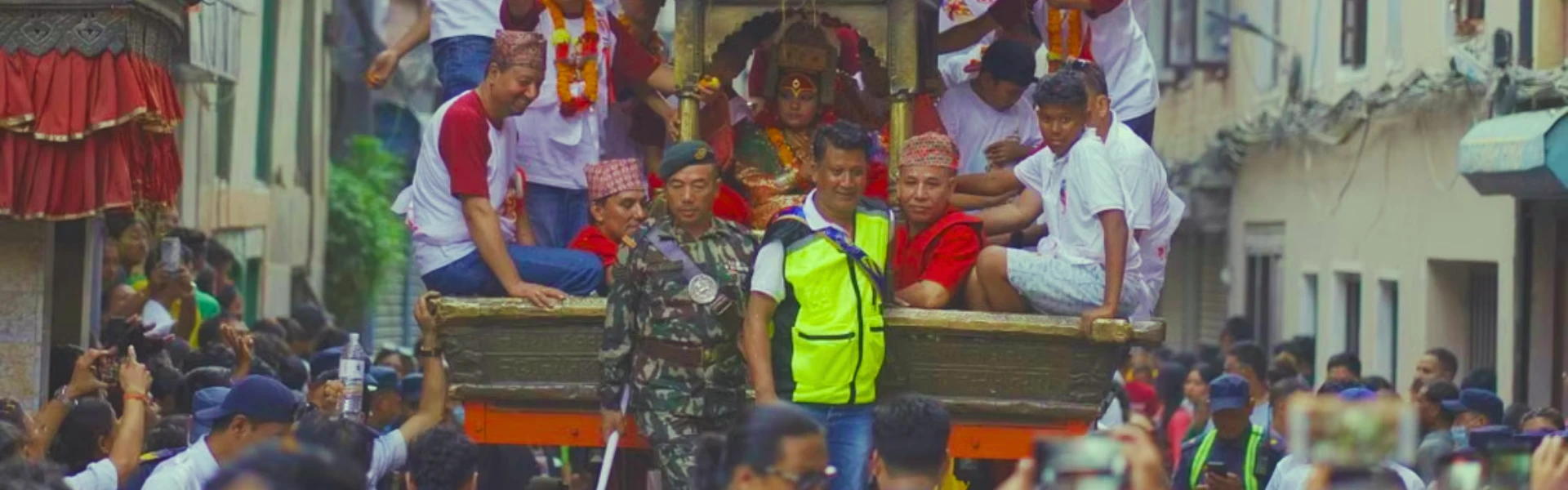
A glimpse of the Divine. Kumari, the Living Goddess of Kathmandu, stepping out of her palace for the annual Kumari Jatra.
Kumari Jatra is one of the major highlights of Indra Jatra, centred around the ceremonial procession of Kathmandu's Living Goddess, the Kumari. During the festival, she is carried through the historic streets in a beautifully decorated wooden chariot, accompanied by smaller chariots representing Ganesh and Bhairav.
The procession passes through several historic neighbourhoods of Kathmandu, allowing devotees and local communities to participate in the festival beyond Basantapur and Kathmandu Durbar Square. Traditional music, crowds, rituals, and the movement of the chariots create a unique atmosphere throughout the old city.
For visitors, Kumari Jatra offers an opportunity to experience one of Kathmandu's most important living traditions and see how religious practices, community participation, and the historic city come together during Indra Jatra. The procession follows different routes on different days, with each route connecting the Kumari to another part of the old city.
The Three Major Kumari Chariot Routes
The Kumari chariot procession takes place over several days and follows different routes through the historic city. The routes allow different neighbourhoods to participate in the festival. The southern route moves towards areas including Maru, Chhikamuga, Jaisidewal and Lagan. The northern route passes through major historic commercial areas including Asan and Indra Chowk. The central route passes through the central old city and includes Kilagal. These routes are important because Indra Jatra is not confined to a single square. The festival spreads throughout the historic heart of Kathmandu. This is why walking through the surrounding neighbourhoods can be just as rewarding as standing inside Basantapur Square.
Where Does Indra Jatra Take Place?
The heart of Indra Jatra is Kathmandu Durbar Square and Basantapur. However, the festival spreads across a much larger section of the historic city. Important locations include:
Basantapur and Kathmandu Durbar Square
This is the main centre of the festival. The Yosin pole is raised here, the Kumari chariot begins its journey, and major ceremonial activities take place around the old palace complex.
Hanuman Dhoka
Hanuman Dhoka Palace provides the historic setting for several important rituals. The surrounding courtyards and temples also become gathering points during the festival.
Indra Chowk
Indra Chowk is one of the most atmospheric locations during Indra Jatra. It is especially significant because of the display of Akash Bhairav.
Asan
Asan is one of Kathmandu's busiest traditional market areas and becomes particularly crowded when the chariot procession passes through. Its historic architecture, narrow streets, and large crowds create an intense festival atmosphere.
Maru
Maru is closely associated with the old city and features several important performances and rituals. It is also an important place to see Pulukisi and other traditional performances.
What Are the Must-Watch Events at Indra Jatra?
If you are visiting Kathmandu during Indra Jatra, there are several events and performances you should look for.
Yosin Thanegu: Watch the ceremonial raising of the sacred pine pole at Basantapur.
Upaku Wanegu: Observe the solemn procession dedicated to family members who died during the previous year.
Kumari Chariot Procession: See the Living Goddess Kumari travel through the historic streets in her wooden chariot.
Ganesh and Bhairav Chariots: Look for the two smaller chariots accompanying the Kumari.
Majipa Lakhe: Experience the powerful masked dance accompanied by traditional drums.
Pulukisi: Look for Indra's white elephant moving through the old city.
Akash Bhairav: Visit Indra Chowk to see the enormous Bhairav mask during its annual public display.
Seto Bhairav: See the White Bhairav at Basantapur when the shrine is opened during the festival.
Traditional Music and Dance: Listen for Dhimay drums and look for masked religious performances in the old city.
Samay Baji: Experience traditional Newari food served during community celebrations and religious gatherings.
Majipa Lakhe Aaju Dance , Majipa Lakhe is one of the most sacred figures of Kathmandu's Newar heritage. Known as the Peaceful Bhairav
Indra Jatra and Newar Culture
Indra Jatra cannot be separated from the cultural identity of the Kathmandu Valley's Newar communities. The festival is supported by community organisations, religious groups, families and traditional institutions that preserve specialised roles across generations. This community participation is one reason the festival has survived for centuries. The festival is not simply something that is performed for visitors. It is a living tradition. People prepare chariots, masks, musical instruments, ritual objects, food and ceremonial spaces. Families participate in religious duties while performers preserve traditional dances and characters.
The streets of Kathmandu therefore become a living museum, but one where the exhibits move, dance, sing, eat, pray, and interact with thousands of people.
The Food of Indra Jatra
Food is another important part of the festival. Traditional Newari dishes such as Samay Baji are closely associated with festivals and community gatherings. A traditional Samay Baji spread may include beaten rice, buffalo meat, black soybeans, ginger, eggs, fish, and other Newari foods. Food is not simply about eating during Yenya. It is also connected with hospitality, ritual, community, and celebration. For visitors, trying traditional Newari food during Indra Jatra provides another way to understand the cultural world surrounding the festival.
Why Indra Jatra Is Important to Kathmandu
Indra Jatra brings together many different aspects of Kathmandu's heritage.
It preserves mythology.
It keeps traditional dances alive.
It maintains ancient chariot building and pulling traditions.
It connects Hindu and Buddhist religious practices.
It honours ancestors.
It celebrates the agricultural importance of rain.
It gives communities a reason to gather.
And it turns the historic city into a shared cultural space.
The festival's importance is therefore not limited to its religious meaning.
It is also an expression of Kathmandu's history and identity.
The Nepal Tourism Board describes Indra Jatra as one of the most important and revered festivals of the Newar community of the Kathmandu Valley.
Indra Jatra 2026: What Visitors Can Expect
For visitors experiencing Indra Jatra 2026, the festival offers an opportunity to see Kathmandu at one of its most culturally active times of year. The 2026 celebration runs from September 23 to September 30, based on the festival schedule provided for this article.
The opening period focuses on the Yosin pole and remembrance rituals. The middle days bring the major chariot processions, masked performances, and public displays of Bhairav. The final day concludes with the lowering of the sacred pole. Because the festival takes place in the narrow streets of the old city, visitors should expect large crowds. If you are photographing the festival, arrive early and be respectful around religious ceremonies and family processions. Remember that many of the people participating are not performers but devotees carrying out religious and community responsibilities.
Experience Kathmandu Through Indra Jatra
There are many ways to see Kathmandu. You can visit its temples. You can walk through its historic squares. You can explore its museums and courtyards. But during Indra Jatra, Kathmandu offers something different. The city itself becomes the experience. Ancient palace squares become gathering spaces. Narrow alleys become procession routes. Temple courtyards become stages. Traditional drums echo between old buildings. A giant elephant made from bamboo moves through the streets. Masked Lakhe dancers appear among crowds. The Kumari travels through the city in her chariot. Bhairav masks emerge for public viewing. Families light lamps for relatives who have passed away. And above it all is the ancient story of a god who came down from heaven searching for flowers and ended up being captured by the people of Kathmandu.
That is the enduring magic of Indra Jatra. It is a festival where mythology is not simply remembered in books. It walks through the streets. It is carried on chariots. It is performed through masks and music. It is shared through food. It is preserved through communities. And every year, as Kathmandu gathers around Basantapur, the ancient story of Indra begins again.
Final Thoughts
Indra Jatra is one of the most extraordinary examples of Nepal's living cultural heritage. Its mythology tells the story of Indra, Parijat flowers, his mother and the souls of the dead. Its rituals honour rain, agriculture, ancestors and the gods. Its streets bring together the Kumari, Ganesh, Bhairav, Lakhe, Pulukisi and countless traditional performers. Its chariots connect different neighbourhoods across the historic city. And its continuation demonstrates how deeply Kathmandu's cultural traditions remain connected to community life. If you are planning to visit Kathmandu during the festival season, make time to explore beyond the main square.
Walk through Maru. Visit Indra Chowk. Experience the atmosphere of Asan. Watch for the Lakhe. Listen to the Dhimay drums. Look for Pulukisi rushing through the alleys. And, if you have the opportunity, witness the Kumari chariot procession. Because Indra Jatra is not just something to watch. It is something to experience. It is Kathmandu telling its own story through gods, ancestors, music, masks, chariots, food, and people.
Indra Jatra is where the mythology of heaven meets the living streets of Kathmandu.
Frequently Asked Question
What is Indra Jatra? Indra Jatra, also known as Yenya, is an eight-day Newar festival celebrated in Kathmandu featuring chariot processions, masked dances, religious rituals, and the Kumari Jatra.
Why is Indra Jatra celebrated? The festival is associated with the legend of Lord Indra's visit to Kathmandu, as well as rain, agriculture, ancestors, and the cultural traditions of the Kathmandu Valley.
Where is Indra Jatra celebrated? The main celebrations take place around Kathmandu Durbar Square, Basantapur, Hanuman Dhoka, Indra Chowk, Asan, Maru, and other historic neighbourhoods of Kathmandu.
Who is the Kumari in Indra Jatra? The Kumari is the Living Goddess of Kathmandu. During Indra Jatra, she is carried through the historic city in a large wooden chariot, accompanied by chariots representing Ganesh and Bhairav.
What can you see during the Indra Jatra? Major attractions include the Yosin pole, Kumari chariot procession, Majipa Lakhe, Pulukisi, Akash Bhairav, Seto Bhairav, traditional music, masked dances, and Newari food.
When is Indra Jatra 2026? The festival schedule supplied for this article places Indra Jatra 2026 from September 23 to September 30. Nepal Tourism Board confirms that Indra Jatra is an eight-day September festival, although its general festival page does not currently display those specific 2026 dates.
Raj Thapa
Founder & Managing Director Raj Kumar Thapa: Founder & Managing Director of the Company, and has over 2 decades of professional experience in the travel and trekking field. Mr. Raj has spent the entirety of his career in the travel & trek organization.


.webp)