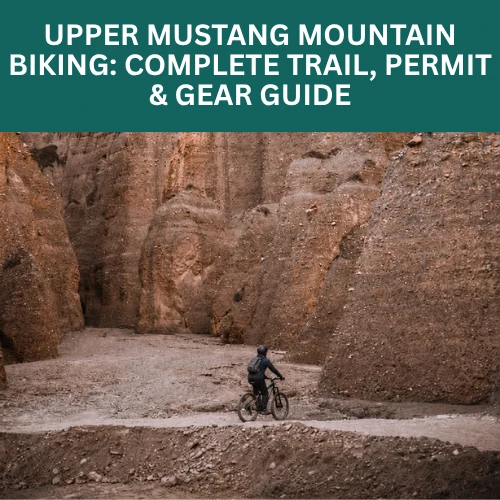
Somewhere past Kagbeni, the last patch of green disappears behind you, and the road turns to windswept grey dust. The Kali Gandaki gorge opens up on one side, cliffs riddled with centuries-old cave dwellings rise on the other, and the only sound left is your engine and the wind. That moment is why riders come back from an Upper Mustang motorcycle tour talking about it years later. Upper Mustang isn't just another motorcycle route in Nepal. It's the former Kingdom of Lo, a Tibetan Buddhist enclave that stayed closed to outsiders until 1992, and it still feels like a place time forgot. In the space of two or three riding days, you leave behind the rice terraces and rhododendron forests of the mid-hills and climb into a high-altitude desert that looks more like the Tibetan plateau than anything else in Nepal: ochre cliffs, wind-carved rock formations, whitewashed gompas, and the walled medieval capital of Lo Manthang sitting behind mud-brick ramparts. What makes this different from a standard Annapurna Circuit ride is the terrain and the isolation. You're riding rough, unpaved mountain track at 3,000–3,840 metres, crossing passes, fording streams, and rolling into villages where yak caravans still outnumber vehicles. It's demanding, genuinely remote, and only open to travelers with the right permits, a licensed guide, and a motorcycle and a rider properly prepared for the altitude and the road surface. That's where planning matters. Restricted-area rules, permit costs, support-vehicle logistics, and altitude pacing all shape whether this trip is the ride of a lifetime or a miserable slog. At A1 Excursion Adventure, we run Upper Mustang motorcycle expeditions regularly, and this guide lays out everything you need to plan one properly, using the current 2026 regulations. permits, route, bike choice, gear, safety, and cost.
Table of Contents
Riding to Mustang: The Last Forbidden Kingdom
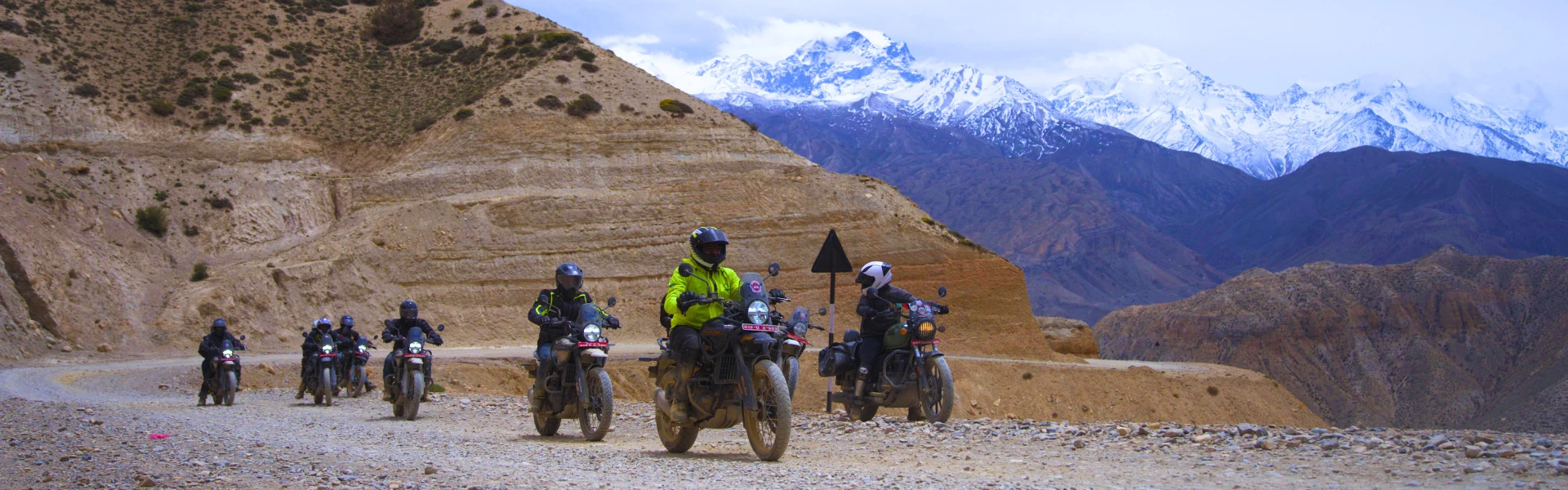
Riding a motorcycle through the dramatic high-altitude landscapes of Upper Mustang, Nepal.
What Makes an Upper Mustang Motorcycle Tour Unique?
Upper Mustang sits in a rain shadow behind the Annapurna and Dhaulagiri massifs, which is why the landscape flips so dramatically once you cross into the restricted zone. Instead of jungle and terraced farmland, you get a high-altitude desert of eroded cliffs, canyons, and scree slopes that look almost lunar.
A few things set an Upper Mustang motorbike tour apart from other rides in Nepal:
A former kingdom, not just a region. Lo Manthang was an independent kingdom until Nepal absorbed it, and the last king, Jigme Dorje Palbar Bista, was still locally respected as royalty until he died in 2016. The walled city still has a palace, four major monasteries, and a layout that hasn't changed much in five centuries.
Tibetan-influenced culture. Language, dress, architecture, and religion here trace back to Tibet, not the Kathmandu Valley. Prayer flags, chortens, and monastery murals dominate the visual landscape.
Cave dwellings and cliff monasteries. The Sky Caves of Mustang, which are thousands of human-made caves cut into sheer cliff faces, are among the least-understood archaeological sites in the Himalaya.
Genuine off-road riding. Much of the track between Jomsom and Lo Manthang is unpaved, rutted, and exposed to wind and river crossings, which is exactly why riders choose it over jeep tours or trekking.
High-altitude exposure. You'll be riding, not just visiting, at elevations up to 3,840 m at Lo Manthang, with the Chöser and Lo La areas pushing close to 4,000 m.
The landscape transition tells the story on its own: leaving Kathmandu or Pokhara, you ride through subtropical mid-hills and pine forest, drop into the Kali Gandaki, which is reputedly the world's deepest gorge at Tatopani and Ghasa, then climb steadily through Jomsom's windy apple-orchard valley before crossing into the restricted zone at Kagbeni, where the terrain turns dry, brown, and dramatic almost overnight.
Where Is the Upper Mustang and How Do You Get There?
Upper Mustang lies in Nepal's Mustang District, tucked against China's Tibetan Autonomous Region, connected to Tibet by the Korala border pass. It sits inside the Annapurna Conservation Area but is administered as a separate restricted zone beginning at Kagbeni village.
Most Kathmandu to Upper Mustang or Pokhara to Upper Mustang motorcycle itineraries follow this general shape:
Ride from Kathmandu to Pokhara (or start directly in Pokhara).
Continue from Pokhara through Beni and Tatopani into the Kali Gandaki gorge.
Reach Jomsom, the administrative hub of Mustang and the last major town before the restricted area.
Cross the checkpoint at Kagbeni, where permits are inspected, and begin the true off-road leg from Jomsom to Lo Manthang.
Ride onward through Chele, Syangboche, Ghami, and Charang to Lo Manthang, the walled capital.
The section from Kagbeni to Lo Manthang is roughly 60–65 kilometers of largely unpaved road. While a Chinese-funded road project has paved and widened stretches of this route over the past several years, riders should still expect long unpaved sections, loose gravel, washboard surfaces, and occasional landslide debris. Conditions can and do change season to season.
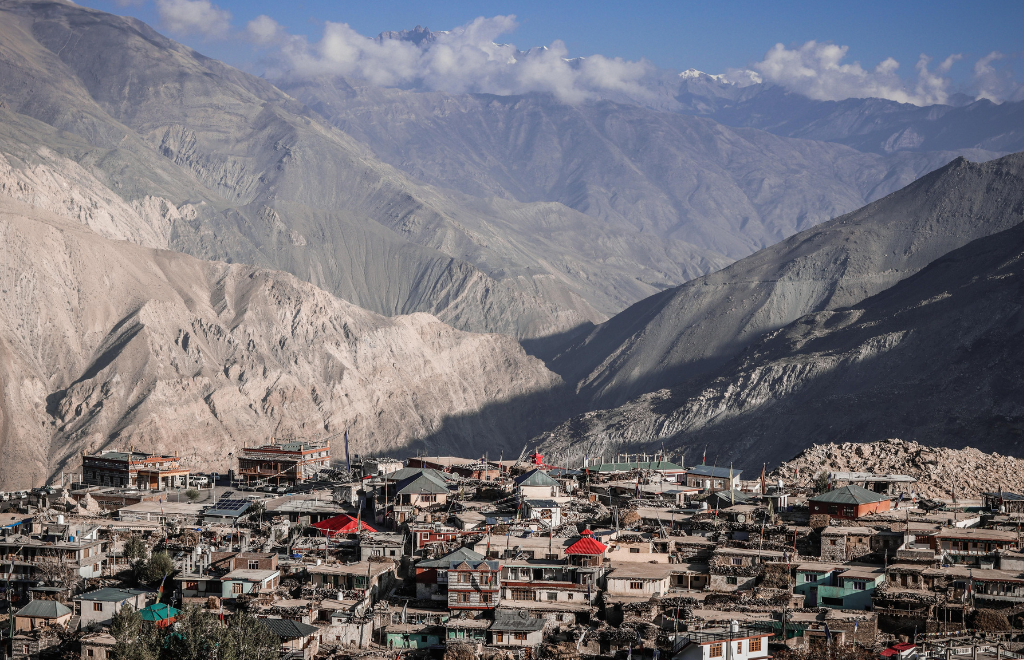
A traditional Mustang village surrounded by dramatic cliffs and high-altitude Himalayan landscapes.
Upper Mustang Permits: What You Actually Need in 2026
This is the part every rider gets wrong if they rely on outdated blog posts, so here's the current picture.
Upper Mustang Restricted Area Permit (RAP)
Upper Mustang has been a government-controlled Restricted Area since it opened to foreign visitors in 1992, because of its sensitive location on the Tibet border. You cannot legally enter the zone north of Kagbeni without a Restricted Area Permit, and this applies to riders on a motorcycle tour exactly as it does to trekkers and jeep travelers.
Here's what matters most, in plain terms:
The permit costs USD 50 per person, per day inside the restricted zone.
A licensed guide is mandatory for every visitor, no exceptions.
You can now go solo. The old rule requiring a minimum group of two travelers has been dropped; a single rider can hold the permit alone.
Key practical points for the RAP:
Issued only through a registered Nepali trekking or tour agency like A1 Excursion Adventure; you cannot apply for it as an independent foreign traveler.
Processed by the Department of Immigration in Kathmandu or Pokhara.
Requires passport copies, passport-sized photos, and your exact entry/exit dates.
Checked at the Kagbeni checkpoint on entry and again on exit; carry the original document, not a photocopy, at all times inside the zone.
A licensed guide from a registered agency remains mandatory for every visitor, solo or in a group.
Children under 10 are typically exempt from the fee, though this should be reconfirmed with your operator at booking.
Because rules have shifted twice in recent seasons and some older government and agency pages still cite the previous flat-fee structure, always confirm the current daily rate and exact permit days with your operator before finalizing flights or an itinerary; this is one area where planning documents genuinely go stale.
ACAP Permit (Annapurna Conservation Area Permit)
Because Upper Mustang sits within the Annapurna Conservation Area, you also need the ACAP alongside the RAP. Unlike the RAP, the ACAP is not a daily fee; it's a single flat entry permit valid for the length of your trip. For 2026, the ACAP costs NPR 3,000 (roughly US$22–25) for foreign nationals and NPR 1,000 for SAARC nationals, with no time limit attached once issued.
Guide and Agency Requirements
A licensed guide is compulsory throughout Upper Mustang, and by extension for any motorcycle expedition into the zone. This isn't red tape for its own sake; guides here handle permit checkpoints, translate with village hosts, know which river crossings are passable after rain, and are trained to recognize altitude sickness symptoms early. For a motorcycle tour specifically, your operator will typically also provide a support vehicle and mechanic, which functions alongside the guide rather than replacing the guide requirement.
Motorcycle-Specific Documentation
Beyond the two conservation-area permits, riders need:
A valid international driving permit or an equivalent recognized license, per your rental or tour operator's requirements.
Vehicle registration and route permission documents for the motorcycle itself, arranged by the tour operator like A1 Excursion Adventure or a rental agency; self-drive rentals crossing into restricted areas typically require additional paperwork beyond a standard Kathmandu rental.
Nepal entry visa, valid passport with at least six months' validity, and passport photos for the various checkpoints along the route.
Bottom line: book through a registered agency that handles the RAP, ACAP, guide assignment, and vehicle documentation as one package. Current rules don't allow you to arrange restricted-area access independently, and checkpoint staff in Kagbeni will turn back anyone without the correct paperwork.
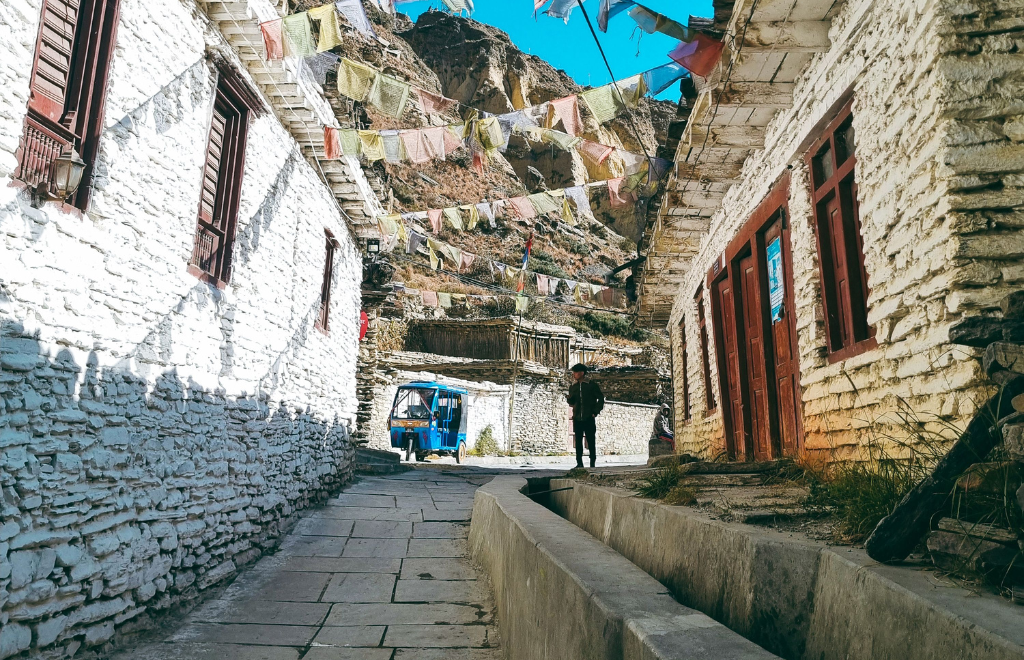
A charming narrow alley lined with traditional stone houses in Marpha Village, Mustang, Nepal.
Choosing the Right Motorcycle for Upper Mustang
The road conditions dictate the bike. This is not a route for a heavy touring cruiser or a low-clearance street bike.
What Works
Royal Enfield Himalayan — the default choice for most operators and riders. Purpose-built for exactly this kind of long-distance, high-altitude, mixed-surface riding: tall suspension travel, good ground clearance, a comfortable upright seating position, and simple mechanicals that are easier to field-repair if something goes wrong far from a workshop. A "Royal Enfield Himalayan Mustang" pairing has become something of a signature combination for riders tackling this route.
Dual-sport and adventure bikes in the 250–450cc range — light enough to muscle through sand and loose gravel, powerful enough to handle the climbs.
What to Avoid
Heavy cruisers or full-dress tourers with low clearance and high weight are a serious liability on washboard gravel and river-bed crossings.
Bikes you haven't ridden off-road before. Upper Mustang is the wrong place to learn how a motorcycle behaves in loose gravel at altitude.
Mechanical Preparation
Before departure, your operator should confirm:
Fresh tires with adequate off-road tread because this route eats worn rubber.
Full service, including brakes, chain, and suspension.
A basic spares kit (levers, cables, spark plug, puncture repair kit) carried either on the bike or in the support vehicle.
Road Conditions on the Upper Mustang Route
Upper Mustang road conditions vary significantly by section and season, and this is the single most important factor in how physically demanding the ride will feel.
Pokhara to Jomsom: Mostly paved or well-maintained road, following the Kali Gandaki valley with a gradual, scenic climb.
Jomsom to Kagbeni: A short transitional stretch, still relatively easy riding, where the landscape starts to dry out.
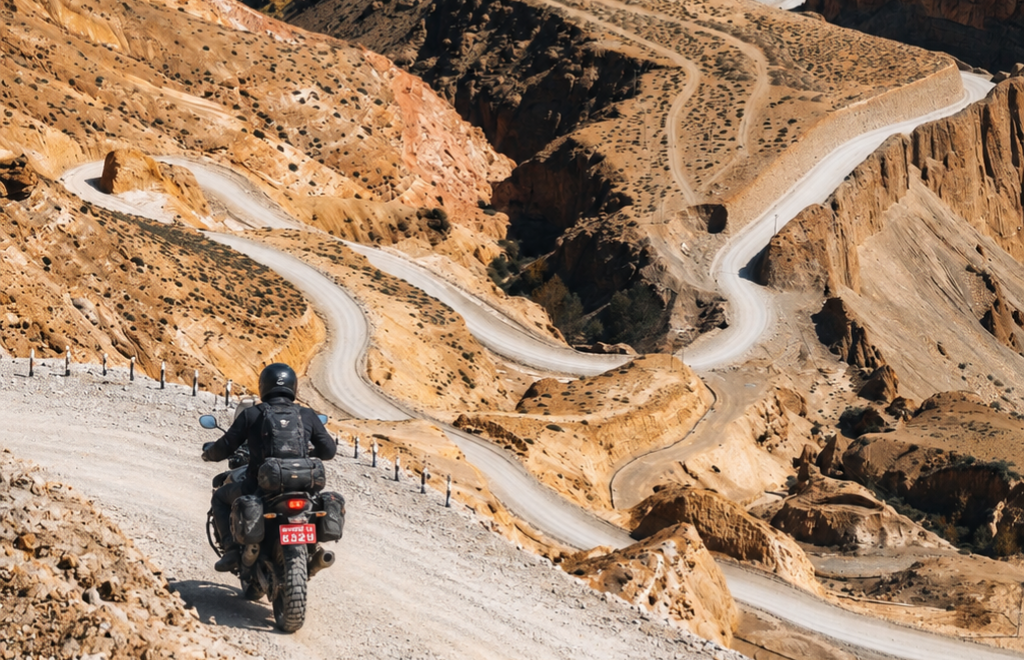
Kagbeni to Chele/Syangboche: The real off-road riding begins here — narrow tracks, switchbacks, and exposed cliffside sections.
Chele to Lo Manthang: A mix of graded gravel, sections of new paving from an ongoing Chinese-backed road project, and rougher unpaved stretches, particularly around Ghami and Charang, where erosion and seasonal landslides can affect the surface.
Side trips (Chöser, Lo La): Some of the roughest and highest riding of the whole trip, rewarded with cave monasteries and sweeping valley views.
Because construction and weather conditions shift year to year, treat any specific description of "paved vs. unpaved" percentages as a snapshot, not a guarantee — your guide and support vehicle driver will know the current state of the road on the day you ride it.
Altitude and Health on an Upper Mustang Motorcycle Tour
Upper Mustang altitude is a real factor even though this is a riding trip, not a trek; you're still exposed to thin air for multiple days running.
Jomsom sits around 2,720 m.
Kagbeni, the restricted-area gateway, is close to 2,800 m.
Lo Manthang sits at approximately 3,840 m.
Side excursions toward Chöser and the Lo La Pass push close to 4,000 m.
Riding at these elevations is less physically taxing than trekking, but altitude sickness doesn't care whether you walked or rode there; it's driven by elevation gain and pace, not exertion. Build in acclimatization by:
Avoiding a single-day jump from low elevation straight to Lo Manthang where possible.
Staying hydrated and limiting alcohol during the riding days.
Knowing the early symptoms of acute mountain sickness (headache, nausea, dizziness, disturbed sleep) and telling your guide immediately if they appear.
Trusting your guide's judgment on descent if symptoms worsen, as this is non-negotiable, even mid-itinerary.
Comprehensive travel insurance that explicitly covers high-altitude motorcycle touring and helicopter evacuation is essential. Given the remoteness of the route, confirm your policy's altitude ceiling and activity coverage before you fly to Nepal, and verify current evacuation and rescue-coordination arrangements with your operator, since procedures in remote restricted areas can change.
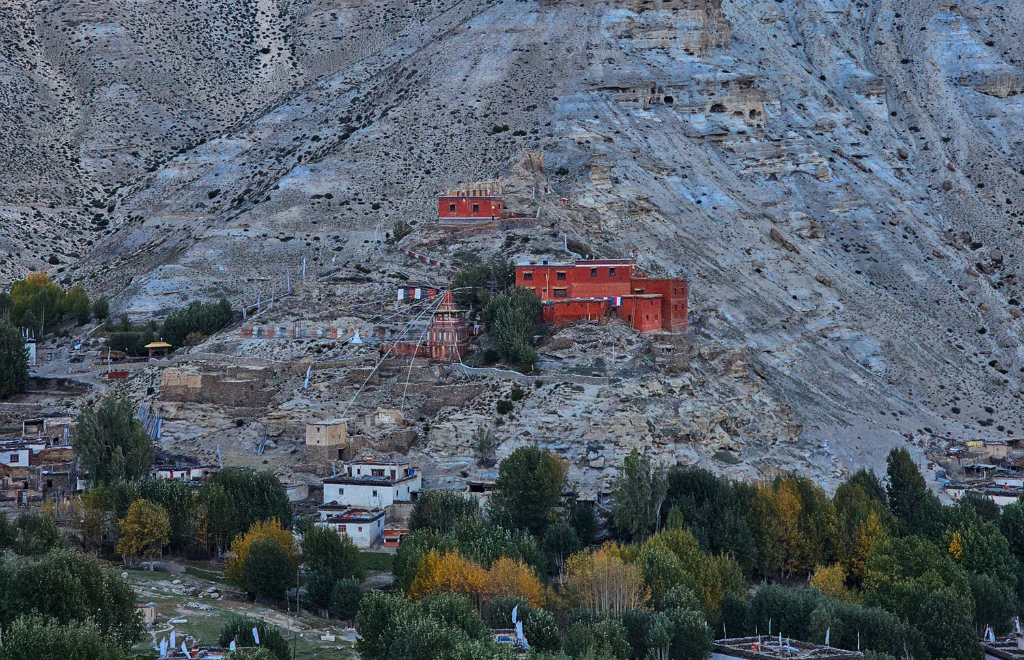
A traditional Buddhist gompa surrounded by the dramatic landscapes of Mustang, Nepal.
Support Vehicles and Safety Logistics for Upper Mustang Motorcycle Trip
Nearly every reputable Upper Mustang motorcycle tour operator, including A1 Excursion Adventure, runs a support vehicle alongside the riding group. This isn't a luxury add-on; it's core to how safely this route can be run.
A support jeep typically carries:
Spare fuel, since gas stations thin out drastically past Jomsom.
A mechanic or basic tool kit for roadside repairs.
Extra water, snacks, and warm layers.
A seat for any rider who develops altitude symptoms or mechanical trouble and needs to continue by vehicle rather than bike.
Luggage, freeing riders to carry only a small daypack.
Riding in a small group with a guide and support vehicle, rather than solo, remains the standard and strongly recommended approach even now that the two-person permit minimum has been lifted; the terrain, altitude, and distance from medical help make backup logistics genuinely important, not just bureaucratic box-ticking.
Weather and Best Time to Ride
Mustang sits in a rain shadow, so even during Nepal's monsoon (roughly June to September) it stays comparatively dry when the rest of the country is soaked, making it one of the few Nepal destinations that's actually rideable in monsoon season. That said, most operators, including A1 Excursion Adventure, recommend these windows:
Spring (March–May): Warming temperatures, clearer mountain views, and the build-up to the Tiji Festival season.
Autumn (September–November): The most popular window with stable weather, good visibility, and comfortable daytime riding temperatures.
Monsoon (June–August): Rideable due to the rain-shadow effect, though the approach route through Pokhara and the Kali Gandaki gorge can see landslides and wet conditions before you reach the drier Mustang zone.
Winter (December–February): Extremely cold at altitude, with the Lo La and Chöser side routes potentially closed by snow; only for well-prepared, experienced cold-weather riders.
The Tiji Festival
If timing allows, riding into Lo Manthang during the Upper Mustang Tiji Festival is a highlight worth planning around. This three-day masked-dance ritual, held in the walled city, reenacts the legend of a deity subduing a demon threatening Mustang, and it draws the region's monks, nobility, and villagers together in one of the most visually striking festivals in the Himalaya. Dates shift yearly on the Tibetan lunar calendar, typically falling in May, so confirm exact dates with your operator well in advance if this is a priority.
Orientation, motorcycle briefing, gear check, and document collection
2
Kathmandu to Pokhara (820 m)
200 km / 6–7 hrs
Asphalt twisties along the Prithvi Highway, following the Trishuli and Marsyangdi rivers
3
Pokhara to Tatopani (1,190 m)
110 km / 5 hrs
Transition from blacktop to broken pavement and dirt trails; natural hot springs
4
Tatopani to Jomsom & Kagbeni (2,810 m)
65 km / 4–5 hrs
Ride through the Kali Gandaki Gorge; permit check at Kagbeni, gateway to Upper Mustang
5
Kagbeni to Ghami (3,520 m) via Chele Pass
65 km / 5–6 hrs
Steep ascents, loose gravel, single-lane cliff roads, Taklam La Pass (3,624 m)
6
Ghami to Lo Manthang (3,840 m) via Charang
35 km / 4 hrs
Cross Tsarang La Pass (3,870 m); arrive at the walled capital
7
Lo Manthang excursion: Chhoser Caves & Kora La border (4,660 m)
80 km round-trip
Explore the ancient Jhong Cave and ride to the Nepal–Tibet border post
8
Lo Manthang to Muktinath (3,760 m)
85 km / 6 hrs
Descend south toward the sacred temple site of Muktinath
9
Muktinath to Marpha/Tatopani (2,530 m)
50 km / 3–4 hrs
Descend into the apple orchards of Marpha along technical riverbed trails
10
Tatopani to Pokhara (820 m)
130 km / 6–7 hrs
Return to asphalt highways
11
Pokhara to Kathmandu
200 km / 7 hrs
Final scenic stretch back to the capital
12
Final departure
----------
Airport transfers arranged by A1 Excursion Adventure
Upper Mustang Motorcycle Tour Cost
Upper Mustang motorcycle tour cost depends heavily on group size, bike model, trip length, and service level, but budget for these major line items:
Restricted Area Permit: US$50 per person, per day inside the zone (variable by itinerary length).
ACAP permit: roughly US$22–25 per person, one-time fee.
Motorcycle rental: varies by model; a well-maintained Royal Enfield Himalayan typically commands a premium over lower-displacement bikes due to demand and mechanical suitability for the route.
Guide and support vehicle: usually bundled into a package rate covering fuel, driver, and mechanic support.
Accommodation and meals: simple teahouse-style lodges past Jomsom, with more comfortable options in Pokhara and Kathmandu.
Travel insurance: covering high-altitude riding and emergency evacuation, which is non-negotiable, and priced separately from your tour package.
Because permit fees changed materially in 2025–2026, treat any total price you see quoted online with some skepticism unless it's dated for the current season — get a specific, itemized quote from your operator rather than relying on older published figures.
Packing List for an Upper Mustang Motorcycle Tour
Full-face helmet, riding jacket and pants with armor, off-road boots, and gloves rated for cold and wind.
Layered clothing for daytime riding temperatures can be warm in the sun, but Mustang's wind chill and nighttime cold are significant even in peak season.
Buff or dust mask for the dry, gravelly terrain that kicks up persistent dust.
Sunglasses or goggles, high-SPF sunscreen, and lip balm, as UV exposure is intense at altitude.
A basic first-aid kit and any personal medication, including a physician-approved altitude sickness medication if you're prone to it.
Cash in Nepali rupees, as card payment is unreliable past Jomsom.
Power bank, since electricity in remote lodges can be limited or metered.
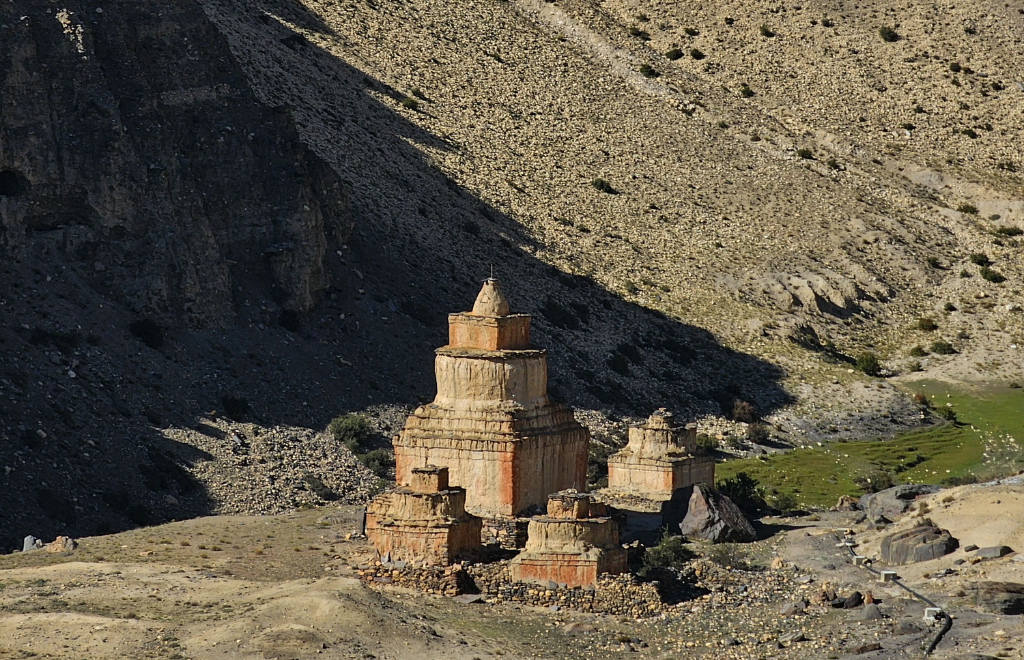
A traditional Buddhist chorten standing beside the road amid the rugged landscapes of Mustang, Nepal.
Alternatives: Trekking and Jeep Tours in Upper Mustang
Motorcycling isn't the only way to experience this region, and it's worth knowing the alternatives when you're deciding what fits your trip.
Both alternatives require the same RAP and ACAP permits described above, since the restricted-area rules apply to the region itself, not the mode of transport.
Final Thoughts
An Upper Mustang motorcycle tour rewards riders who prepare proper permits sorted through a registered agency like us, a bike suited to the terrain, realistic altitude pacing, and a guide and support vehicle who know the route in its current condition. Do that groundwork, and the ride from Kagbeni's checkpoint to the walled gates of Lo Manthang becomes exactly what draws riders back to Nepal again and again: a genuinely remote, culturally rich, physically real Himalayan adventure that very few places on earth can match.
Is an Upper Mustang motorcycle tour hard to ride? It requires real off-road experience — loose gravel, river crossings, and altitude combine to make this more demanding than a typical Nepal motorcycle tour. Riders should be comfortable handling a bike outside of pavement before attempting it.
Do I need a guide for an Upper Mustang motorbike tour?
Yes. A licensed guide from a registered agency is mandatory for every visitor to the restricted area, regardless of group size, including solo riders under the 2026 rule change.
How much does the Upper Mustang Restricted Area Permit cost?
As of the 2026 fee reform, the RAP costs US$ 50RAP costs USD 50 per person, per day, with a minimum-stay charge, replacing the previous flat USD 500-for-10-days structure. Confirm the current rate with your operator, since Nepal's permit policy has changed more than once in recent seasons.
Can I ride solo to Lo Manthang?
As of March 2026, the mandatory two-traveler minimum for restricted-area permits has been removed, so a single rider can now obtain a permit. A licensed guide is still required regardless of group size.
What's the best time for a Lo Manthang motorcycle tour?
Spring (March–May) and autumn (September–November) offer the most stable weather and clearest mountain views. Monsoon is rideable due to Mustang's rain-shadow location, and winter is only for well-equipped, experienced cold-weather riders.
What motorcycle is best for the Upper Mustang? T
Royal Enfield Himalayan is the most common choice thanks to its ground clearance, suspension travel, and mechanical simplicity, though other dual-sport bikes in the 250–450cc range also work well.
Raj Thapa
Founder & Managing Director Raj Kumar Thapa: Founder & Managing Director of the Company, and has over 2 decades of professional experience in the travel and trekking field. Mr. Raj has spent the entirety of his career in the travel & trek organization.

.webp)