An Upper Mustang photography tour isn't just a trip with a camera in your bag; it is a deliberate, well-planned expedition built around light, geography, and centuries of Tibetan Buddhist culture that most travelers never get close enough to frame properly.
I have walked into Lo Manthang before sunrise more times than I can count, waiting for the first light to hit the whitewashed palace walls while the town was still silent. That first flash of gold across a 15th-century fortress never gets old, and it is the reason I keep bringing photographers back to this high-desert kingdom year after year.
Upper Mustang sits in the rain shadow of the Annapurna and Dhaulagiri ranges, meaning the landscape looks nothing like the green, forested trails most people associate with Nepal. Instead, you are treated to wind-carved canyons, ochre and crimson cliffs, mud-brick villages clinging to hillsides, and night skies so pristine that the Milky Way looks close enough to touch. Add in the region's historic status as a restricted kingdom only opened to outside visitors in 1992, and you have a destination where culture, architecture, and geology remain wonderfully preserved.
Table of Contents
Why Upper Mustang Is One of Asia's Most Extraordinary Photography Destinations
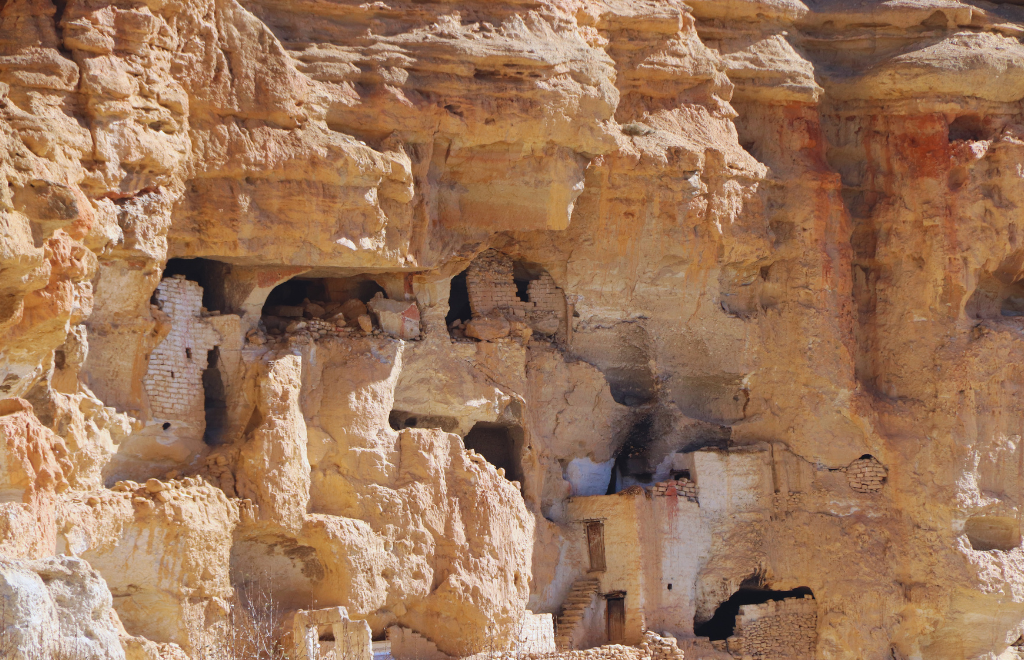
A glimpse of the ancient caves hidden in Mustang's towering cliffs.
From Ancient Kingdoms to High-Altitude Desert Landscapes
Upper Mustang was once the independent Kingdom of Lo, and it still retains that fierce, independent identity. The walled city of Lo Manthang, the ruins of ancient fortresses crumbling on the ridgelines, and complex cave systems carved into sheer cliff faces thousands of years ago all tell a story that a wide-angle lens can only begin to capture.
Layering that rich history onto a landscape resembling the Tibetan Plateau or the American Southwest reveals why photographers describe this place as otherworldly rather than merely scenic.
What Makes Upper Mustang a Paradise for Landscape and Cultural Photography
Three distinct elements make this region a dream for visual artists:
Dramatic, Ever-Changing Light: Driven by high altitude and dry, crisp air.
Preserved Tibetan Buddhist Heritage: A remarkably high concentration of active, centuries-old monasteries and chortens.
Visual Compression and Variety: Drastically different environments—cliffs, caves, riverbeds, mountain passes, and medieval alleys—are packed into a single, cohesive route.
How Many Days Do You Need for an Upper Mustang Photography Tour?
Photography changes the math on itinerary planning. A standard trekker moves through a location and keeps walking; a photographer needs to arrive early, wait for the light, work multiple compositions, and sometimes return the next morning if weather patterns disrupt the shot.
Because of this, our itineraries are engineered differently from standard trekking packages.
The 12-Day Overland Photography Tour: Maximizing Sunset and Sunrise Locations
This jeep-based itinerary is designed for creators who want maximum image opportunities without the physical demands of multi-day backpacking.
Optimal Viewpoint Access: Private 4WD jeeps quickly reposition you between sunrise and sunset points.
Efficient Routing: Comfortable travel between Jomsom, Kagbeni, Chhoser, Lo Manthang, Dhakmar, and Muktinath.
Gear-Friendly: Ideal for photographers carrying heavy setups, multiple bodies, or altitude-sensitive gear.
The 18-Day Photography Trek: Reaching Untouched Eastern Valleys
For purists who want to walk the ancient trade routes, this itinerary trades speed for deep access.
Remote Side Valleys: Reaches isolated regions like Yara and the wilderness approaches to Luri Gompa.
Hidden Compositions: A walking pace allows you to spot unique perspectives and leading lines a vehicle would bypass.
Untouched Vantage Points: Unparalleled access to high ridges overlooking Ghami and Tsarang.
Upper Mustang Photo Tour Comparison: 12-Day Overland vs. 18-Day Trek
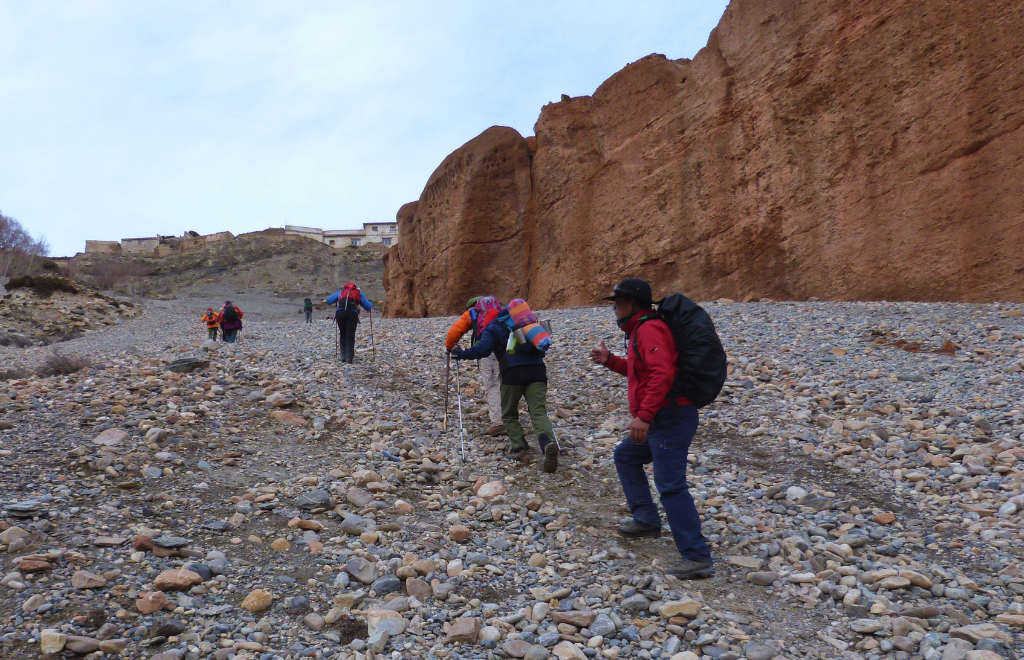
The A1 Excursion team trekking through the breathtaking Upper Mustang region.
Feature
12-Day Overland Tour
18-Day Trek
Physical Demand
Low to Moderate
Moderate to High
Photography Access
Fast, highly efficient
Deep, highly remote
Pacing
Fast repositioning
Slow, exploratory
Ideal For
Time-limited professionals, commercial creators
Landscape purists, documentary photojournalists
Premier Upper Mustang Photography Packages by A1 Excursion Adventure
We run three distinct, highly specialized packages designed specifically for visual storytelling. If you are weighing options against a standard trek, the difference is simple: our itineraries are built around light and access, not just covering daily mileage.
The Overland Fine Art Expedition (Comfort-Focused): We utilize private, high-clearance jeeps to ensure you are in position for golden hour at key locations. Group sizes are kept strictly limited so you never have to compete for tripod placement.
The Wilderness Trekking Workshop: Exploring Untouched Nomadic Horizons: This is our deepest route, targeting remote landscapes, active nomadic herding settlements, and hidden valleys. It is perfect for photographers comfortable with rustic teahouses in exchange for rare, uncrowded compositions.
The Sacred Tiji Festival Media Tour (Cultural & Portraiture): Timed exactly around the annual Tiji Festival, this package secures excellent placement inside the walled city of Lo Manthang. Our team helps you frame the striking, spinning Chham (masked dances) and authentic monastic life while maintaining deep respect for local religious customs.
The A1 Excursion Advantage: Our guides possess extensive regional expertise and profound geographical knowledge of this terrain. They know exactly which courtyard catches the first rays of light, when the winds will kick up dust for atmospheric frames, and how to navigate local protocols seamlessly.
When booking a Mustang photo tour Nepal package, this specialized expertise is the key to coming home with a world-class portfolio.
The Ultimate Location Shooting Guide for Upper Mustang
To build a compelling visual narrative, you must know where to point your lens, what time to shoot, and how to frame the diverse Upper Mustang landscape locations.
Kagbeni: Medieval Alleys and the Windswept Gate of the Kali Gandaki
As the traditional gateway to the upper region, Kagbeni rewards those who slow down. Its dark, narrow mud-brick alleyways create dramatic contrast, where a 24–35mm lens captures the beautifully compressed, historic feel of the old town.
Best Time: Early morning, before foot traffic peaks and the midday wind begins.
Composition Tip: Walk down to the Kali Gandaki riverbed. Use the wide, stone-filled banks as leading lines pointing directly toward the towering peaks of Nilgiri.
Dhakmar: Capturing the Legendary Crimson Sedimentary Cliffs at Sunset
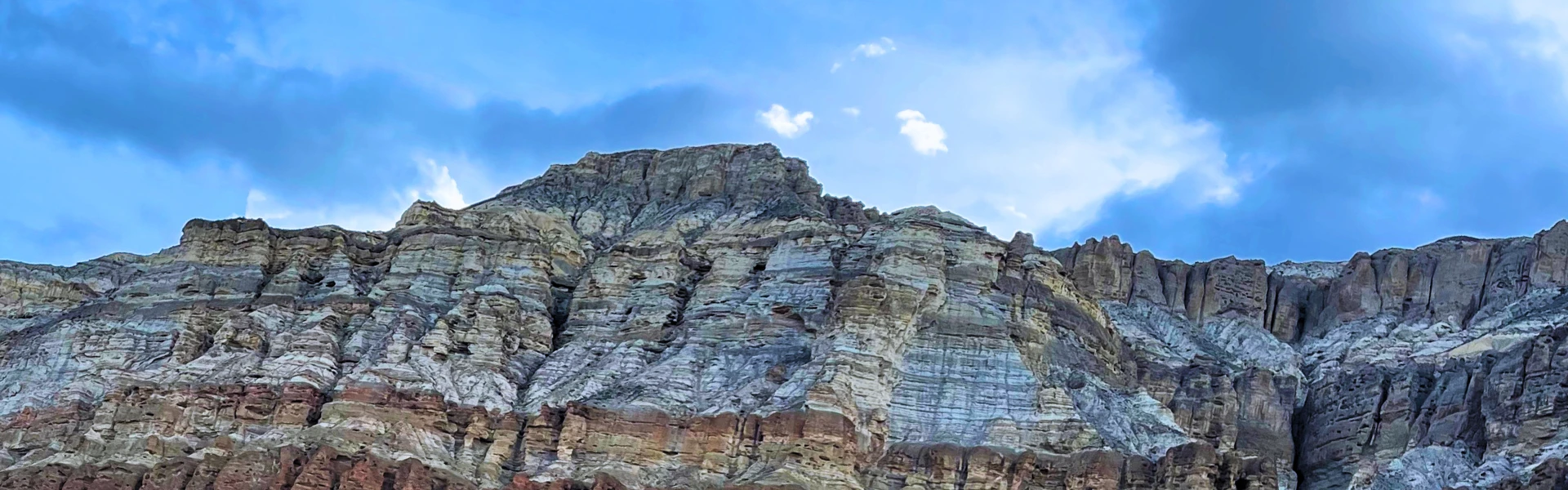
Dhakmar features towering, fluted clay cliffs that glow with an almost unbelievable crimson intensity under the right lighting conditions. It is a cornerstone of any successful dhakmar red cliffs photography session.
The Golden Hour Window: The iron-rich cliffs transition from bright orange to deep, saturated blood-red during the final 30 minutes before the sun dips below the horizon.
Framing: Use an ultra-wide lens to capture the massive scale of the cliffs against the valley floor, or use a telephoto (70–200mm) to isolate the dramatic, wind-carved patterns in the sedimentary rock.
Tsarang: Ancient Mud-Brick Walls, Fortresses, and Portraiture
Tsarang’s giant white-and-red monastery and the ruins of its ancient palace (Dzong) offer highly compelling architectural photography. Because the village moves at a relaxed pace, it is also one of the finest places in the region for authentic, unhurried portrait work.
Best Time: Mid-morning for balanced light on the palace facades; late afternoon for warm, side-lit tones on the monastery walls.
Portrait Tip: Use a fast 35mm or 50mm prime lens to capture environmental portraits of Loba elders against weathered wooden doorways.
Lo Manthang: Ancient Mud-Brick Walls, Fortresses, and Portraiture
The walled city of Lo Manthang is the centerpiece of any professional Lo Manthang photo guide. Behind its towering protective walls lies a labyrinth of whitewashed homes, active monastic schools, and historical gates.
Best Time: Sunrise is crucial. Position yourself outside the eastern wall to capture the golden light illuminating the primary gateway as herds of goats are driven out to pasture.
Interior Guidance: Monasteries here are highly sacred. Always check with your guide before shooting inside; camera flash is strictly prohibited to protect ancient pigments.
Ghar Gumba (Lo Gekar Monastery)
Considered one of the oldest active Tibetan Buddhist monasteries in the world, Ghar Gompa is adorned with beautiful stone carvings and paintings.
Best Time: Midday, when overhead sunlight streams through high clerestory windows and doorways, naturally illuminating the ancient stuccos.
Technique: Use a fast prime lens (f/1.8–f/2.8) and high ISO settings to capture the rich interior textures without relying on artificial flash.
Chhoser Sky Caves: Distant Cliff Architecture and Cave Murals
The Chhoser cave complex consists of multi-story, man-made dwellings carved vertically into sheer clay cliffs, some dating back over 2,000 years.
Best Time: Late morning, when the sun directly illuminates the cave openings.
Scale Contrast: Place a human subject in a cave doorway to truly emphasize the immense, honeycombed scale of the cliff face.
Luri Gompa: Distant Cliff Architecture and Cave Murals
Reaching the 14th-century rock-cut monastery of Luri Gompa requires navigating a remote side valley, making it an extraordinary highlight for photography.
The Cave Interior: Inside the dome-shaped chamber rests a highly decorated clay chorten surrounded by some of the most remarkably preserved frescoes in the Himalaya.
The Long View: A 100–400mm lens is invaluable on the approach trail, allowing you to compress the wild, needle-like clay spires surrounding the monastery against the vast sky.
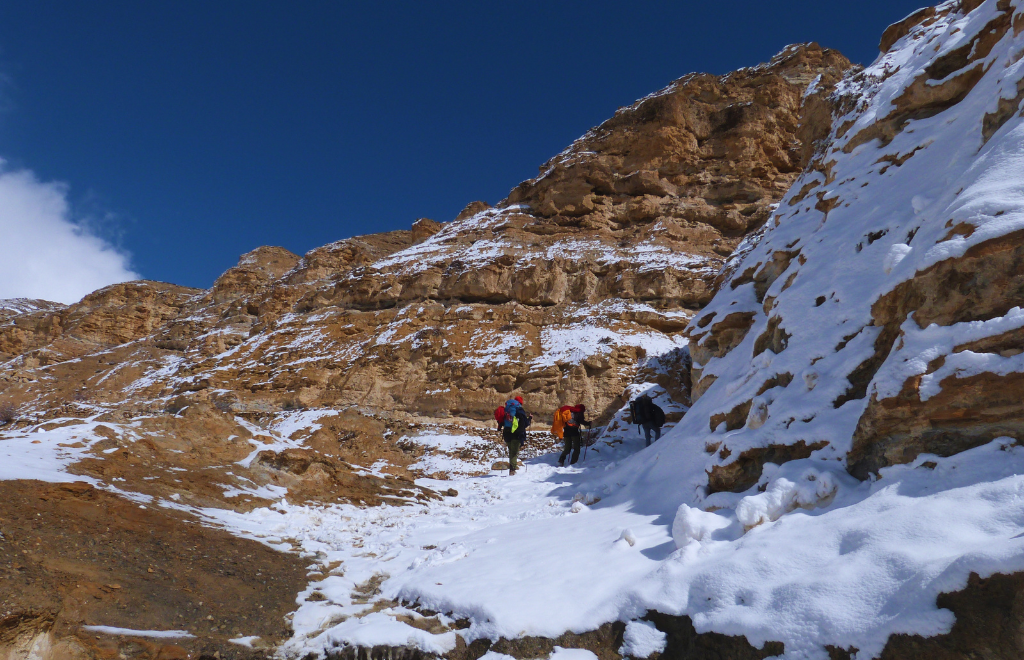
Experiencing the beauty of Upper Mustang Trekking in winter.
Essential Camera Gear and Protection Strategy for High Desert Shoots
Mustang’s environment is incredibly demanding on electronics. Dust, high wind, and freezing nights mean that selecting the right camera gear for the Upper Mustang setup is critical to your project's success.
Lens Choices: Balancing Wide-Angle Caves and Telephoto Compression
Wide-Angle (14–24mm or 16–35mm): Essential for wide landscape vistas, the interior of sky caves, and the narrow alleyways of Lo Manthang.
Telephoto Zoom (70–200mm or 100–400mm): Vital for compressing the vast, layered clay formations, capturing isolated chortens on distant ridges, and capturing respectful, candid cultural frames.
Fast Prime (35mm or 50mm f/1.8): A lightweight, low-light lifesaver for dark monastery interiors and intimate environmental portraits.
Combating the Elements: Wind, Sand, and Dust Defense Systems
The afternoon winds blowing up the Kali Gandaki Gorge carry fine, abrasive quartz dust.
Avoid Lens Changes: Whenever possible, use two camera bodies with your primary lenses pre-mounted, or step inside a building/vehicle to change glass.
Protective Filters: Keep high-quality UV filters on your lenses at all times to prevent wind-blown grit from scratching your elements.
Cleaning Routine: Bring a sturdy rocket blower and fine lens brushes. Never rub a dusty lens directly with a cloth without blowing off the loose grit first.
Power Management: Keeping Batteries Warm and Charged on Sub-Zero Nights
At altitudes over 3,800 meters, overnight temperatures drop rapidly, draining lithium-ion batteries even when your camera is turned off.
Insulation: Sleep with your camera batteries inside your sleeping bag, close to your body heat.
Charging: While most teahouses along the main route offer solar or generator charging for a small fee, bringing a high-capacity, cold-resilient power bank is highly recommended for remote stretches.
Technical Light Conditions, Scouting, and Astrophotography Potential
Golden Hour Dynamics on Arid Sedimentary Strata
Because Upper Mustang is an arid high-altitude desert, its visual appeal relies entirely on texture, shadows, and subtle color gradients rather than lush greenery. The midday sun washes the canyons out into a flat, blinding beige.
Your creative window occurs when the low-angle sun rakes across the landscape, carving deep shadows into the eroded clay structures and intensifying the warm earth tones.
Zero Light Pollution: Shooting the Milky Way over Ancient Chortens
With exceptionally clear air, dry climate, and virtually non-existent light pollution, Upper Mustang is one of the premier locations in Asia for astrophotography.
Astrophotography Setup:
Lens: 14-24mm at f/2.8 (or faster)
Settings: ISO 3200–6400, 15 to 20-second exposure (using the "Rule of 500" to prevent star trailing)
Foreground: Position a historic stone chorten or monastery silhouette in the bottom third of your frame to provide scale and historical context under the arcing core of the Milky Way.
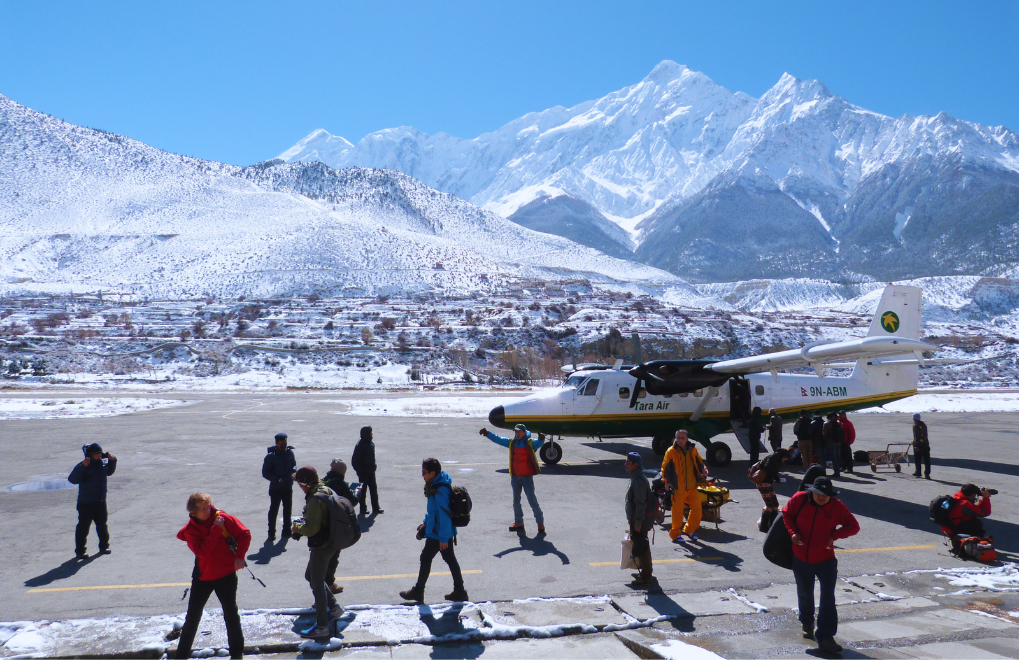
Jomsom Airport, located in the Mustang region of Nepal.
Exact Breakdown of Upper Mustang Permit Cost and Regulations for Creative Professionals
Navigating the permit process is a mandatory step when planning your high-altitude visual expedition. Because Upper Mustang sits along a sensitive border zone and remains a protected cultural region, strict entrance rules apply to all travelers.
The permit structure includes three primary items: the Upper Mustang Restricted Area Permit (RAP) at $50 USD per person per day, the Annapurna Conservation Area Project (ACAP) permit for approximately NPR 3,000, and a standard TIMS card for approximately NPR 2,000.
1. Upper Mustang Restricted Area Permit (RAP)
Cost: $50 USD per person / per day
Scope: Covers all areas north of Kagbeni, including Tsarang, Dhakmar, Chhoser, and the walled capital of Lo Manthang.
Details: The RAP is the primary special entry permit for Upper Mustang. Under the flexible daily fee system, you pay only for the exact number of days spent inside the restricted zone. Foreign travelers cannot apply independently; RAPs must be issued through a government-registered Nepalese agency.
2. Annapurna Conservation Area Project (ACAP) Permit
Cost: Approximately NPR 3,000 (~$23 USD)
Scope: Covers the entire Annapurna Conservation Area, which encompasses the entry routes into Mustang.
Details: This is a one-time fee per trip with no daily expiration limit. Funds collected from the ACAP permit directly support local environmental conservation, waste management, trail upkeep, and heritage preservation across the region.
3. Trekkers' Information Management System (TIMS) Card
Cost: Approximately NPR 2,000 (~$15 USD)
Scope: Official trekker safety and tracking registry across Nepal.
Details: The TIMS card logs your entry dates, travel route, emergency contact information, and guide details across government checkpoints, ensuring rapid response coordination in the event of severe weather or medical emergencies during overland transit.
Permit Fee Summary
Permit Type
Cost Structure
Issuing Authority
Key Function
Restricted Area Permit (RAP)
$50 USD / day
Department of Immigration
Entry clearance for restricted northern zones
ACAP Permit
NPR 3,000 (~$23)
NTB / NTNC (online)
Funds local ecosystem & trail conservation
TIMS Card
NPR 2,000 (~$15)
NTB / TIMS Counter
Logs emergency contacts & trekker safety data
Essential Permit Rules for Foreign Photographers
Mandatory Licensed Guide: Independent, unguided trekking or driving in Upper Mustang is strictly prohibited. You must travel with a government-licensed guide.
Agency Processing: Restricted Area Permits cannot be acquired at individual immigration counters or self-service checkpoints. Applications must be submitted through an authorized agency.
Zero Administrative Hassle with A1 Excursion Adventure: When you book your expedition with A1 Excursion Adventure, our logistics team handles all passport verification, visa cross-checks, RAP submissions, and permit collections on your behalf before you set foot on the trail.
Commercial Camera and Drone Regulations in Protected Monasteries
Drone Photography: Flying a drone requires specialized authorization from the Civil Aviation Authority of Nepal (CAAN) and the Ministry of Home Affairs. Unauthorized drone flights can result in immediate confiscation and severe fines. Our team can assist in navigating the necessary paperwork for professional productions.
Monastery Etiquette: Always obtain permission through your guide before photographing monks, prayer sessions, or monastery interiors. Respect signs indicating where photography is strictly prohibited.
Physical Conditioning and Altitude Management for Photographers
Weight Management: Backpack Pacing with Heavy Camera Bodies and Tripods
Trekking at altitudes up to 4,000 meters while carrying a heavy camera backpack can exhaust even fit individuals.
Pacing: We highly recommend using a modern camera harness system to distribute weight evenly across your chest and shoulders rather than your neck.
Support: Our itineraries feature robust support crews. You can leave your main luggage, heavy tripods, and extra backup gear with our experienced team and carry only your immediate shooting bodies in your daypack.
Acclimatizing on the Arid Plateau to Protect Your Creative Edge
Altitude sickness impairs decision-making, physical stamina, and creative focus. The dry air of the trans-Himalaya accelerates dehydration, which mimics and worsens altitude symptoms.
Hydration: Drink at least 4 to 5 liters of water daily.
Pacing: Our photography itineraries build in gradual elevation gains, allowing your body to adapt naturally so your mind stays sharp and creative when framing shots.
Frame Your Ultimate Visual Story with A1 Excursion Adventure
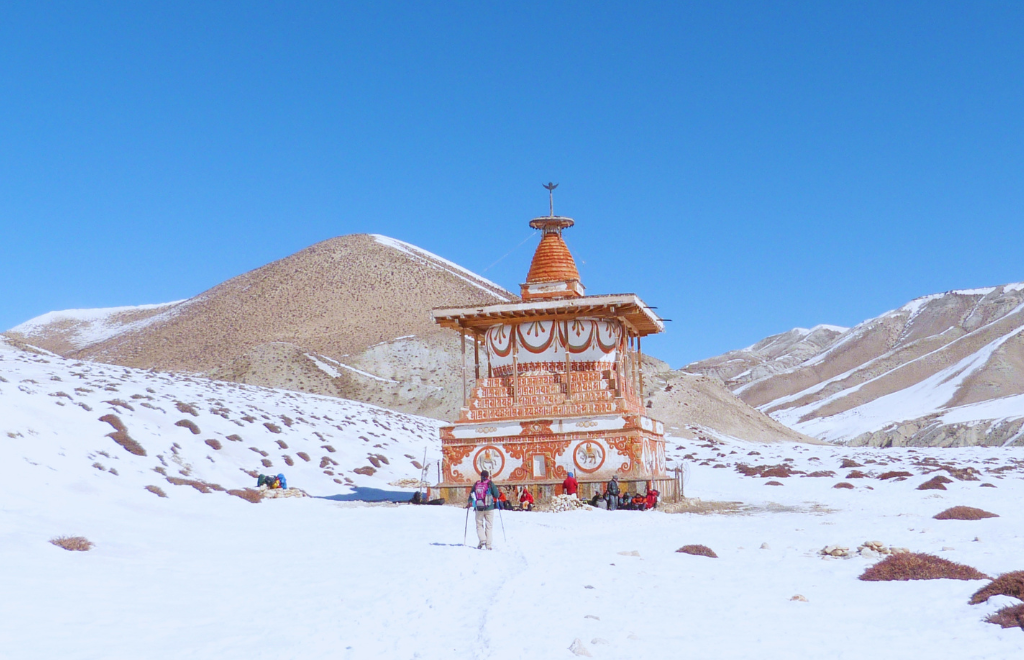
Chortens seen during the Upper Mustang Trek.
Upper Mustang is not simply a location; it is an expedition into a preserved era of Himalayan history. Documenting its wind-swept canyons, vibrant crimson cliffs, and deep spiritual heritage requires specialized logistical expertise, respect for local customs, and an itinerary designed around light.
1. Is electricity reliably available for charging camera batteries?
Yes, major stops like Kagbeni, Tsarang, and Lo Manthang have reliable solar or micro-hydro power. However, charging speeds can be slow, and power can occasionally go down during bad weather. Bringing a reliable, high-capacity power bank is highly recommended.
2. What is the best season for an Upper Mustang photography tour?
Spring (March to May) offers excellent clarity, mild weather, and the spectacular Tiji Festival. Autumn (September to November) provides the sharpest atmospheric clarity, deep blue skies, and ideal astrophotography conditions. Because the region lies in a rain shadow, it can also be safely visited during the summer monsoon months when the rest of Nepal is rainy.
3. Are A1 Excursion Adventure’s trekking guides local to Upper Mustang?
Our hand-selected guides are chosen for their extensive regional expertise, deep cultural knowledge, and profound understanding of the specific logistics of Upper Mustang, ensuring a safe, authentic, and highly professional journey.
4. What is the altitude profile of this journey?
The average altitude ranges between 2,800m (Kagbeni) and 3,840m (Lo Manthang), with some high passes reaching just over 4,000m. Because this is lower than the Everest Base Camp or Annapurna Circuit routes, acclimatization is highly manageable on a properly paced itinerary.
Raj Thapa
Founder & Managing Director Raj Kumar Thapa: Founder & Managing Director of the Company, and has over 2 decades of professional experience in the travel and trekking field. Mr. Raj has spent the entirety of his career in the travel & trek organization.


.webp)