Upper Mustang Tea Houses: What the Rooms, Facilities, and Nights Are Really Like
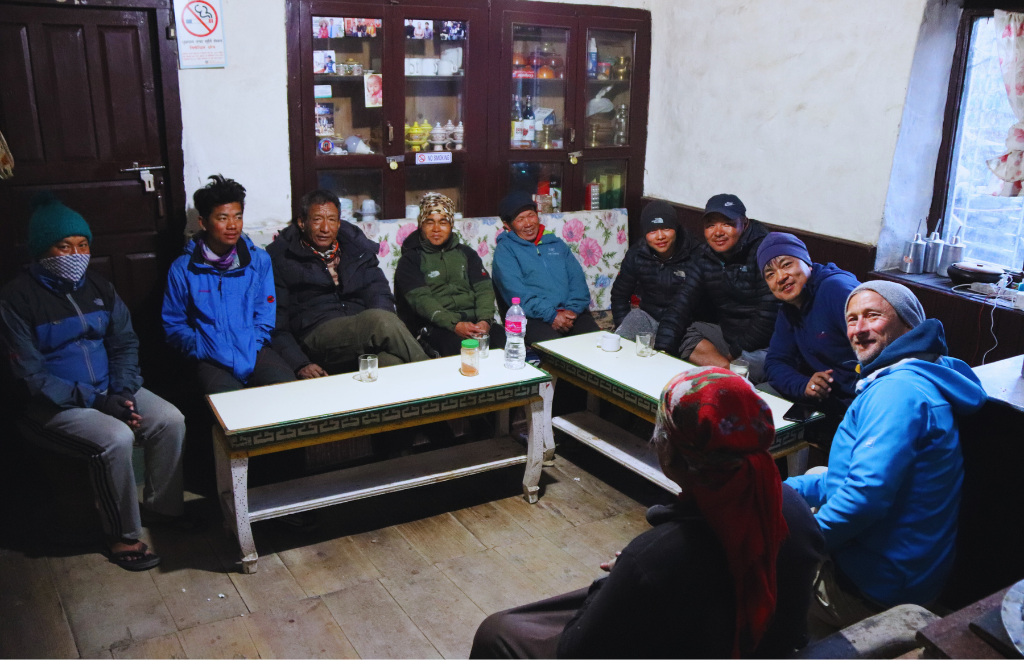
The door of a Mustang lodge almost always opens into the warmest room in the building. A cast-iron stove anchors the center of the dining hall, burning dried yak dung or juniper wood through the afternoon and into the evening. Long wooden tables surround it. By late afternoon, the room gradually fills with trekkers unlacing their boots, guides exchanging news with lodge owners in Nepali or Lo-Ke dialect, and someone's wet socks hanging near the stovepipe, despite the universal understanding that they shouldn't be. This central room becomes the heart of daily life on the trek. Routes get debated here. Altitude headaches get compared. Tea gets refilled without asking.
How Upper Mustang Tea Houses Are Built (And Why It Matters at Night)
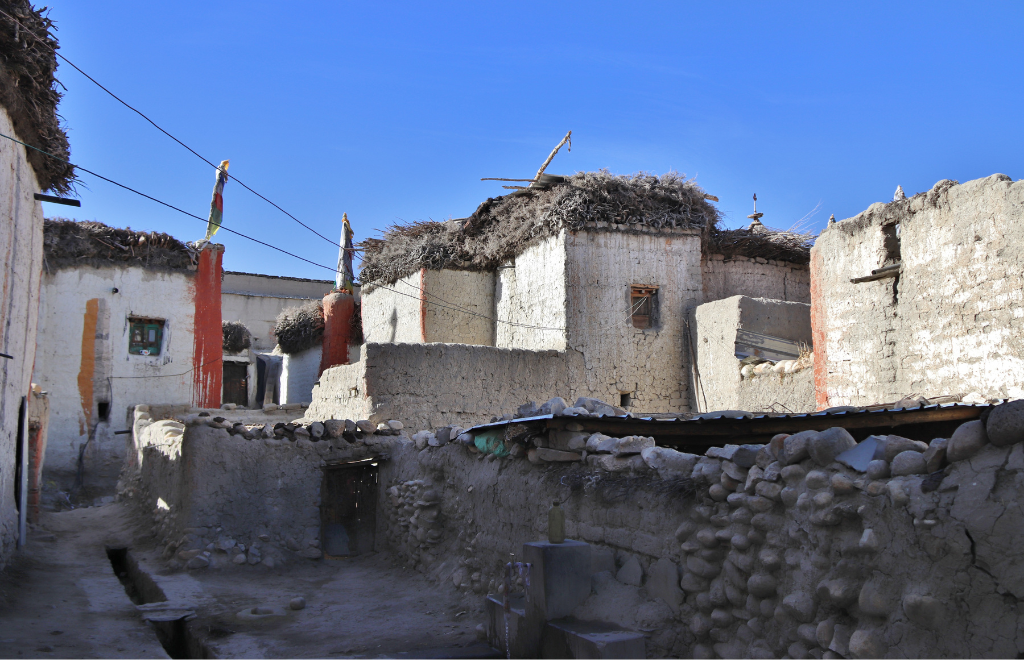
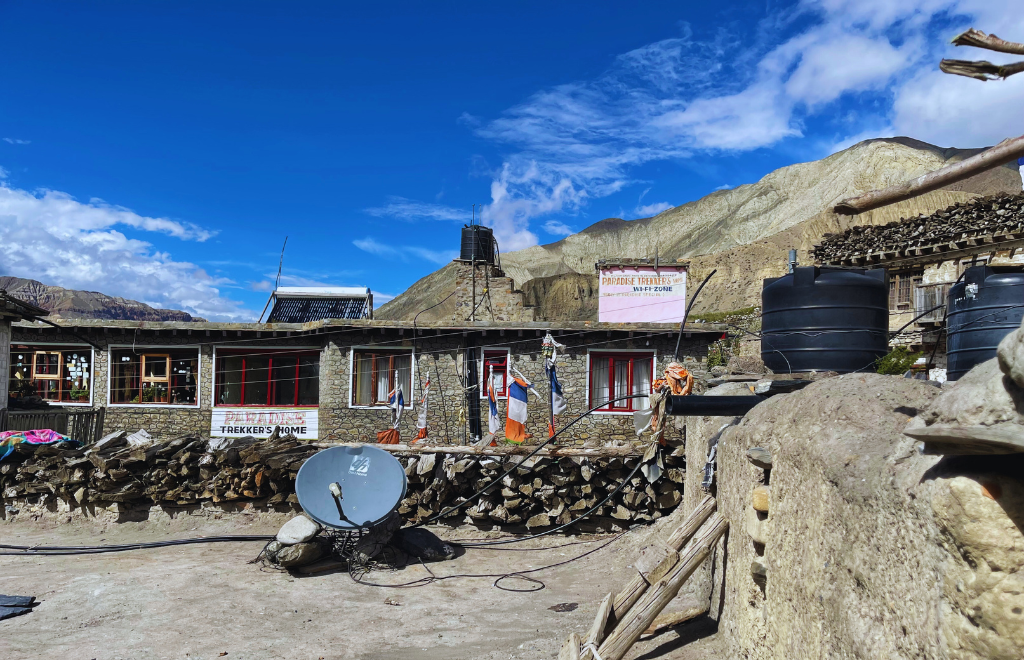
Upper Mustang tea houses follow Lo-Pa building traditions developed over centuries in response to extreme cold, high winds, and the near-total absence of timber. Walls are constructed from packed mud brick, sometimes two feet thick, designed to absorb daytime heat and release it slowly through the night. Ceilings sit low. Windows stay small. Every design choice reflects the same priority: keep the warmth inside. Walking through a lodge in Ghami or Charang, the smell of old wood smoke has settled permanently into the beams. Floors are stone or compacted earth. Staircases are steep and narrow. Nothing about these buildings was designed for tourists; they were built for survival, and that practicality gives them a character no purpose-built hotel can replicate.
What Your Tea House Room Actually Looks Like
Sleeping rooms are functional rather than comfortable. Most have twin beds with foam mattresses, a small table, and a window, sometimes facing the valley and sometimes the courtyard wall. Blankets are available, but carrying a sleeping bag is recommended for extra comfort. Even in late spring, nighttime temperatures above 3,500 meters regularly drop to freezing or below. A four-season sleeping bag is not optional equipment. Trekkers who arrive with a three-season bag spend the night watching the ceiling and waiting for sunrise. Bathrooms in smaller villages are shared, located outside the main building, and usually squat-style. Some larger lodges in Kagbeni and Lo Manthang offer attached bathrooms with Western-style toilets, but these remain the exception. Hot showers are available throughout the route but are rarely included in the room rate, except for paying NPR 300–500 for a bucket shower heated on the stove.
WiFi, Hot Showers, and Electricity: Facilities Available on the Upper Mustang Trek
| Facility | Availability | Notes |
Electricity | Solar-powered in most villages | Charging in dining rooms; NPR 200–400 per device |
Hot Showers | Available throughout | Bucket-style; NPR 300–500 extra |
WiFi | Kagbeni and Lo Manthang | Starlink in Lo Manthang; speeds vary |
Mobile Signal | From Kagbeni, the signal reliability fades north of Chele | NCELL signals drop around Samar |
Heating | Dining room stove only | Bedrooms are unheated
|
Carry a power bank of at least 20,000 mAh. Outlet access in dining rooms is limited and shared among all guests. The competition for charging space in Lo Manthang during peak season is a real and mildly comic phenomenon every veteran of the route knows well.
Because Upper Mustang has no centralized booking system, rooms at popular lodges fill up quickly in October and April. A1 Excursion Adventure pre-books accommodation along their itineraries specifically to prevent trekkers from arriving after a long day to find the lodge full, which is a situation that does happen to independent travelers and is far less amusing on the trail than it sounds in retrospect.
Upper Mustang Trek Food Guide: What You'll Eat from Kagbeni to Lo Manthang
Kitchens along the upper Mustang Trail wake before the trekkers do. By the time boots hit the cold floor in the morning, the stove is already burning, and the smell of fried dough and boiling tea has filled the lower floor of the lodge. Meals here follow a rhythm shaped by altitude, logistics, and generations of high-plateau cooking.
Why Dal Bhat Is the Best Thing You Can Eat in Upper Mustang
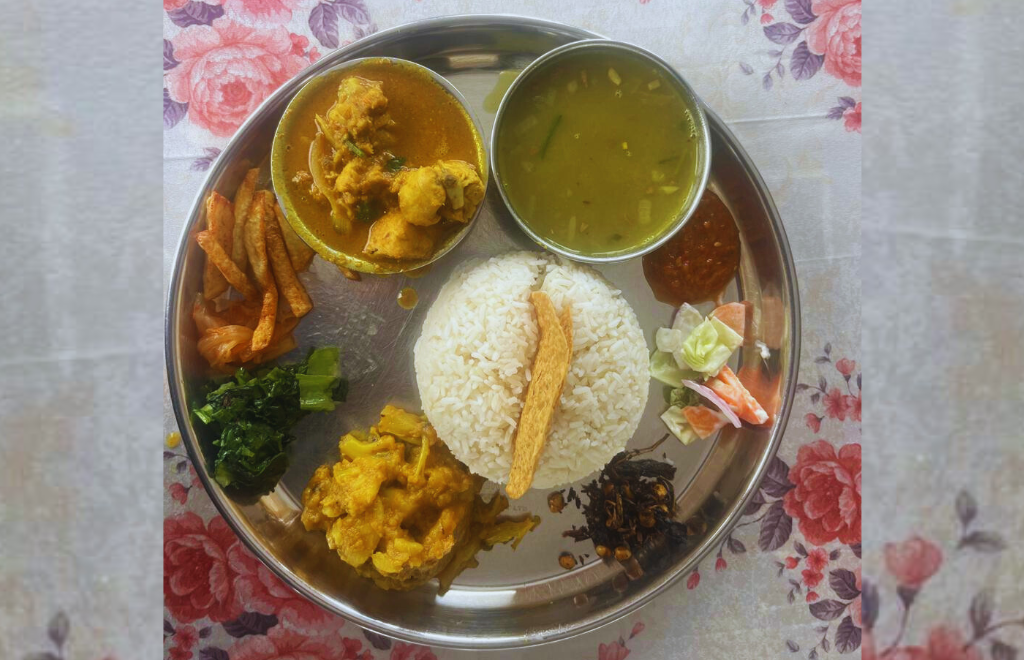
Nothing fuels a Himalayan day like a proper dal bhat. A wide metal plate arrives at the table: rice at the center, lentil soup poured generously over the top, vegetable curry on the side, and a sharp, fermented pickle served in a small bowl beside it. It looks simple. It is simple. It is also, at 3,500 meters after six hours on a dusty trail, precisely what a body needs.
The open secret of dal bhat is the refill policy. Most tea houses offer unlimited portions. Guides across Nepal share a phrase that every trekker eventually memorizes: "Dal Bhat power, twenty-four hours."
At altitude, where digestion slows and appetite fluctuates, the combination of complex carbohydrates, plant protein, and salt provides steady, sustained energy in a way that processed snacks and imported food rarely match. Trekkers who commit to dal bhat as their primary meal consistently outperform those who spend energy chasing pasta and pizza.
Beyond Dal Bhat: The Tibetan Food Culture of Upper Mustang
Centuries of trade across the Himalayan passes between Lo Manthang and Tibet left a permanent mark on Mustang's kitchen.
- Thukpa appears on nearly every menu as a deep bowl of noodle soup with vegetables, sometimes egg, and occasionally a small amount of dried meat. After a cold morning crossing between Chele and Samar, a bowl of thukpa eaten beside the stove, while steam rises from wet jackets, is one of the finer experiences available at altitude.
- Thenthuk goes further. Instead of cut noodles, the dough is hand-pulled into thick, uneven pieces that hold the broth differently, heavier, more filling, better suited for the end of a long day than the middle of one.
- Tingmo, the soft steamed bread common across Tibetan communities, pairs naturally with vegetable curry. Tibetan bread, fried, slightly chewy, denser than it looks, arrives at breakfast with honey or jam and disappears quickly.
These dishes represent the everyday reality of Tibetan food that Mustang trekkers encounter throughout the route, and they are consistently more satisfying than the Western-influenced alternatives available in larger lodges.
Yak Butter Tea (Su-Chya) in Upper Mustang: The Science and the Culture Behind the Cup
Most first-time visitors take a sip of butter tea, pause, and look uncertain. It tastes nothing like tea in the familiar sense. The flavor is savory rather than sweet, with a richness from yak butter that coats the mouth. The texture is closer to a thin broth than a beverage. Some trekkers put the cup down and don't return it. Others develop a quiet appreciation over several days that they didn't entirely anticipate. There is a practical reason behind every ingredient. Yak butter provides dense calories and fat useful at elevations where the body burns fuel faster than usual. Salt aids hydration by helping retain fluids lost through exertion and dry mountain air. An unusual cultural curiosity is actually a physiologically well-designed high-altitude drink. Try it twice before forming an opinion. The second cup is almost always better than the first.
Western Food in Upper Mustang: What's Available and What to Order Instead
Lodges in Kagbeni and Lo Manthang offer menus that include pancakes, pasta, fried rice, and occasionally pizza. These dishes exist because trekkers ask for them, and in the largest villages, the supply logistics make them possible. The honest guidance: order them occasionally, but don't rely on them. Ingredients travel north by mule or jeep from Jomsom and Pokhara, sometimes spending several days in transit. A dal bhat made with mustard greens picked from the kitchen garden that morning and lentils sourced locally will always outperform a margherita pizza assembled from ingredients that arrived four days ago. Freshness, at altitude, matters more than variety.
Food Safety in Upper Mustang: What to Eat, What to Avoid, and How to Stay Well
Experienced guides consistently recommend a primarily vegetarian diet above Kagbeni. Chicken and yak meat sometimes spend multiple days in transit without refrigeration before reaching remote kitchens. Eggs, lentils, vegetables, and locally made dairy are considerably safer options and remain available throughout the route. For drinking water, avoid buying bottled water above Jomsom, as a bottle that costs NPR 40 in Pokhara can reach NPR 250 in Lo Manthang. Purify water using a SteriPen, purification tablets, or a portable filter. Boiled water is available in most lodges on request.
Typical Upper Mustang Tea House Menu
Category | Common Dishes |
Breakfast | Tibetan bread, pancakes, porridge, eggs |
Lunch | Dal bhat, fried rice, noodle soup |
Dinner | Dal bhat, thukpa, thenthuk |
Drinks | Butter tea, ginger tea, instant coffee |
Typical Meal Costs during Upper Mustang Trek
Meal | Dish Options | Approx. Cost (NPR) |
Breakfast | Tibetan bread, eggs, porridge, and pancakes | 300–500 |
Lunch | Dal bhat, thukpa, noodle soup | 600–1000 |
Dinner | Dal bhat, thenthuk, pasta (larger villages) | 500–1000 |
Drinks | Butter tea, ginger tea, black coffee | 100–250 |
Tea Houses (lodge) Along the Route: Food and Accommodation from Kagbeni to Lo Manthang
Kagbeni (2,810m)
Crossing the Kali Gandaki bridge, dust drifted across the valley floor as we arrived just after midday. Kagbeni, the last village before the Restricted Area, hums with trekkers finalizing gear and supplies. Lodges sit among apple orchards, and small bakeries sell apple pie, raksi, and crumble made from local fruit. That evening, a warm apple crumble with a thin pour of cream was a simple but memorable treat at 2,810 meters.
Chele & Samar (3,000–3,360m)
Climbing out of the valley, the landscape shifts to dry red cliffs and sparse vegetation. Family-run lodges double as kitchens and living rooms, with children doing homework beside steaming bowls of soup. Menus are limited but generous, and prayer flags flutter outside the single window, catching the afternoon light.
Ghami (3,520m)
Ghami sits beside one of Mustang’s longest mani walls, with lodges arranged around central courtyards. Thick walls and low doorways preserve warmth, and horses are sometimes tethered overnight. Breakfast here deserves special mention: buckwheat pancakes with local honey, thick, nutty, and energizing for the morning climb.
Charang (3,580m)
Quieter than Lo Manthang, Charang offers calm evenings beside a large red monastery. When Thenthuk is eaten slowly by the stove, with extra bread brought without asking, it creates a relaxed, welcoming atmosphere.
Lo Manthang (3,810m)
Arriving in the walled city gives the sense that the trek has truly reached its destination. Narrow lanes link whitewashed courtyards, and rooftop lodges overlook the royal palace and the surrounding plateau. For the first time in days, espresso machines appear, and coffee tastes remarkable after a week of instant granules. Plan at least two nights here to explore the city and its surroundings fully.
For a more detailed look at the tea houses in Upper Mustang, themselves, the rooms, costs, and local hospitality, please check out our in-depth guide on Upper Mustang Tea Houses
Why Logistics Matter More in Upper Mustang Than on Most Nepal Treks
Unlike many trekking regions in Nepal, Upper Mustang requires more planning and coordination than simply following a marked trail. The region remains a restricted area with limited infrastructure, and logistics are not self-managing. There is no centralized reservation system for tea houses, and accommodations operate independently in each village. If a lodge is full during peak trekking months such as October or April, finding an alternative room can quickly become complicated. Infrastructure is also limited. There are no ATMs past Jomsom; mobile signal becomes unreliable north of Samar; and internet access is available only in a few villages, such as Kagbeni and Lo Manthang. When unexpected situations may arise, such as a missed permit, a full lodge, or a trekker needing medical attention, resolving them usually depends on local relationships and experience.
For this reason, choosing a reputable trekking agency like A1 Excursion becomes more than an administrative detail. It directly affects how smoothly your journey unfolds.
Understanding the Upper Mustang Permit Process
Upper Mustang is one of Nepal’s restricted trekking regions, and visiting it requires multiple permits. The main permit is the Restricted Area Permit (RAP), which currently costs $ 50 USD per person per day. In addition to the RAP, trekkers must also obtain:
- Annapurna Conservation Area Permit (ACAP)
- TIMS Card (Trekkers’ Information Management System)
These permits must be processed through a registered trekking agency and require specific documentation and coordination with government offices in Kathmandu or Pokhara.
Experienced operators like A1 Excursion Adventure typically manage this process for trekkers, ensuring all paperwork is completed before the journey begins. Need help arranging your Upper Mustang permits? Contact us to start planning your Upper Mustang journey.
For a detailed breakdown of costs, rules, and how to obtain these permits, read our complete Upper Mustang Permit Guide.
Booking Accommodation in Upper Mustang: What Agencies Do That You Can't Do Alone
Because Upper Mustang tea houses operate independently, rooms are typically reserved through guides or agencies rather than online booking platforms. Organized trekking itineraries usually include pre-arranged accommodation in each village along the route. This ensures that trekkers arrive at the end of the day to a confirmed room and a prepared meal, rather than having to search for a place to stay after a long day of hiking. During peak seasons, particularly October and the spring trekking months, this advance coordination can make a significant difference in comfort and planning.
How Much Does Food and Accommodation Cost on the Upper Mustang Trek?
Typical Daily Costs (Independent Trekkers)
Expense | Daily Estimate |
| Accommodation | $10–20 USD |
| Food and drinks | $15–25 USD |
| Total daily average | $30–45 USD |
Note that packaged itineraries through an agency like A1 Excursion Adventure typically include accommodation and meals, removing the daily calculation entirely and often representing better overall value, particularly given price inflation in remote villages.
What to Pack for Food and Comfort on the Upper Mustang Trek
Water and food safety:
- SteriPen UV purifier or water purification tablets
- Portable water filter as backup
- Reusable insulated bottle (liquids freeze above 3,500m overnight)
Energy and nutrition:
- Trail mix, nuts, and dark chocolate for between-meal energy
- Electrolyte sachets for altitude hydration
- A small supply of preferred snacks from Pokhara or Kathmandu — availability disappears quickly north of Kagbeni
Practical essentials:
- Power bank of at least 20,000 mAh
- Nepali rupees in cash — no ATMs exist past Jomsom
- Four-season sleeping bag — non-negotiable regardless of travel month
For a detailed breakdown on what to pack for the Upper Mustang Trek, read our complete Upper Mustang Trek Packing List Guide.
How A1 Excursion Adventure Handles Upper Mustang Logistics End to End
A1 Excursion Adventure is a government-registered trekking company with over two decades of experience organizing journeys across the Himalayas and is also featured in Lonely Planet Nepal's guidebook. Their Upper Mustang trips handle all the essential logistics, including permits, accommodation, and experienced local guides, allowing trekkers to focus on the cultural and landscape experience rather than administrative details.
Popular Upper Mustang Packages
These packages typically include permits, guide and porter support, accommodation, and airport transfers, ensuring a smooth and well-organized journey in one of Nepal’s most remote trekking regions.
Upper Mustang: Where Simplicity Is the Point
Long after the trek ends, most travelers find it's the kitchens they remember most clearly, not just the trails, in the Mustang region. The smell of lentils simmering beside a wood stove. The warmth of a dining room crowded with tired trekkers trading stories across long tables. The quiet satisfaction of finishing a full plate of dal bhat while the wind moves hard against the windows and the mountains beyond sit entirely indifferent to the weather. Understanding the realities of food and accommodation in the Upper Mustang trek means arriving prepared, not over-equipped, not under-informed, and not surprised by the simplicity of what this landscape offers. With the right preparation, the right agency behind the logistics, and a willingness to eat what the locals eat and sleep where they sleep, Upper Mustang stops being a remote trekking objective and becomes something harder to explain and easier to remember, which is one of the few places left on a Himalayan trail where the journey still feels genuinely far from everywhere else.
Ready to experience it yourself? A1 Excursion Adventure's Upper Mustang Cultural Expedition handles permits, accommodation, and logistics end-to-end. Contact us to plan your next trek adventure here in Nepal.
Additional Frequently Asked Questions
Do tea houses in Upper Mustang provide blankets?
Yes, most tea houses provide thick blankets in every room. However, nights above 3,500 meters can become extremely cold, even in late spring and autumn. Trekkers should still carry a four-season sleeping bag to stay warm during the trek.
Can you get coffee during the Upper Mustang trek?
Coffee is available in most tea houses, usually in the form of instant coffee or simple black coffee. In larger villages such as Kagbeni and Lo Manthang, some lodges serve espresso or cappuccino, especially during the main trekking seasons.
Is drinking alcohol common during the trek?
Local alcohol, such as chang (a fermented barley drink) or Mustang apple brandy, is sometimes available in tea houses. While it can be tempting after a long day of walking, guides usually recommend limiting alcohol at high altitude because it can affect hydration and acclimatization.
Are there bakeries in Upper Mustang?
Yes, Kagbeni is known for its small bakeries that serve apple pie, apple crumble, and fresh bread made from local Mustang apples. These bakeries are popular rest stops for trekkers entering or leaving the restricted region.
How many days does the Upper Mustang trek usually take?
Most trekking itineraries last 12 to 14 days, including travel time and acclimatization stops. Many trekkers spend two nights in Lo Manthang to explore nearby monasteries, caves, and traditional villages before beginning the return journey.

.webp)

.webp)