Which Districts Require a Nepal Restricted Area Trekking Permit?
The new directive reinforces the legal requirement that all foreign nationals must secure government-issued permits before entering restricted regions. These areas remain regulated due to their proximity to international borders, ecological sensitivity, and cultural significance.
Restricted Districts Covered Under Restricted Area Trekking Permit Nepal
The policy applies to thirteen officially designated restricted districts across Nepal, including several of the country’s most sought-after trekking destinations:
Additionally, other less-visited restricted districts include:
- Humla
- Mugu
- Bajhang
- Bajura
- Darchula
- Northern Sankhuwasabha
Officials emphasized that despite the new flexibility for solo trekkers, these regions will continue to operate under controlled access systems to ensure border security, environmental protection, and preservation of traditional communities.
Can Solo Travelers Get a Restricted Area Permit? Yes, Here's What Changed
One of the most significant changes introduced under the updated regulation is the formal authorization of permits for individual trekkers. Previously, foreign nationals were required to travel in groups of at least two people to obtain a Restricted Area Permit. According to government officials, the change was introduced following sustained feedback from tourism stakeholders, particularly the Trekking Agencies' Association of Nepal.
Spokesperson Tikaram Dhakal confirmed that the decision was made on Chaitra 8 (March 21) after reviewing industry grievances. He noted that many travelers experienced logistical challenges when attempting to find trekking partners solely to meet permit requirements. With the implementation of the Nepal restricted area trekking permit reform, those limitations have now been removed.\
Why the Old Two-Person Rule Created "Ghost Permits" — and Why It's Now Abolished
The abolition of the minimum group requirement also marks the end of a long-standing administrative workaround widely used in the trekking industry, known as “Ghost Permits.” Under the previous system, agencies sometimes added a temporary second name to meet the two-person requirement even when only one traveler intended to trek. While technically compliant with regulations, the practice created unnecessary administrative complexity. The new policy eliminates the need for such measures, streamlining permit issuance and improving transparency across the tourism sector.
How to Apply: Nepal's New Online Restricted Area Trekking Permit System
Alongside the regulatory reform, the Department of Immigration has transitioned to a fully digital permit application system. The new platform is designed to simplify the application process for foreign travelers and trekking agencies.
Key Features of the Online Permit System
- Faster permit approvals
- Reduced paperwork
- Improved data accuracy
- Pre-arrival permit processing
- Enhanced administrative efficiency
Under the new system, registered agencies can submit permit applications using a traveler’s:
- Passport details
- Visa application ID
- Travel itinerary
This capability allows permits to be processed even before a trekker arrives in Nepal, significantly reducing delays during peak trekking seasons.
Official Assistance Contact
For inquiries related to trekking permit provisions, authorities have provided a dedicated support line:
Department of Immigration Contact Number: +977 9761423636
Officials stated that the new digital system aims to make the permit issuance process hassle-free, fast, and user-friendly.
Rules Every Trekker Must Know Before Trekking a Restricted Area in Nepal
While the new regulation allows solo permits, the Department of Immigration has clearly outlined mandatory compliance requirements. These conditions are designed to ensure safety, accountability, and adherence to national regulations.
Agency Involvement Requirement
- All permit applications must be submitted through a registered trekking agency.
- Foreign nationals are not permitted to apply independently.
- This rule ensures that authorities maintain oversight of trekking activities in sensitive regions.
Mandatory Guide Requirement
A licensed trekking guide must be assigned to every restricted area trek.This requirement applies to:
- Solo trekkers
- Couples
- Groups
Authorities emphasized that professional supervision remains essential due to the challenging terrain and limited infrastructure in remote mountain regions
Rescue Responsibility Clause
Under the updated framework, the trekking agency responsible for issuing the permit must assume full legal and financial responsibility for emergency rescue operations if required.
This includes:
- Emergency coordination
- Medical evacuation
- Communication with authorities
- Logistical support
The clause ensures that rescue operations can be conducted quickly and effectively in high-risk environments.
Legal Compliance Requirement
All trekking arrangements must comply with existing national laws and regulations. Authorities stressed that the introduction of solo permits does not reduce the responsibility of travelers or agencies to follow established safety and administrative procedures.
The 1:7 Guide-to-Trekker Ratio Explained
To improve safety and ensure effective supervision of trekking activities, the Department of Immigration has introduced a standardized group size limit. Officials noted that large groups make it difficult for a single guide to maintain adequate oversight. As a result, the following rule has been implemented:
- One trekking guide may lead up to seven trekkers per group.
- If the number of trekkers exceeds seven, additional guides must be assigned.
Purpose of the 1:7 Guide Ratio
The regulation aims to:
- Enhance trekker safety
- Improve emergency response capability
- Strengthen supervision
- Reduce operational risks
Safety experts consider the ratio consistent with international best practices in remote expedition management.
Safety vs. Freedom: Balancing Access and Responsibility While Restricted Area Trekking Nepal
The new regulation represents a careful balance between expanding travel opportunities and maintaining strict safety oversight. Allowing solo permits increases accessibility for independent travelers. At the same time, mandatory guide requirements and agency responsibility ensure responsible tourism management. Authorities described the reform as a modernization initiative designed to:
- Support tourism growth
- Improve administrative efficiency
- Maintain safety standards
- Protect sensitive regions
Fact Box: Nepal Restricted Area Trekking Permit
Policy Highlights
Policy Element | New Rule (2026) |
Minimum Group Size | Solo trekkers allowed |
| Permit Requirement | Mandatory for all foreign trekkers |
| Application Method | Through a registered agency only |
| Guide Requirement | Mandatory |
| Guide-to-Trekker Ratio | 1 guide per 7 trekkers |
Rescue Responsibility | Agency legally responsible |
| Permit System | Fully online System |
| Effective Date | March 21–22, 2026 |
Let A1 Excursion Adventure Help you with your restricted area permit
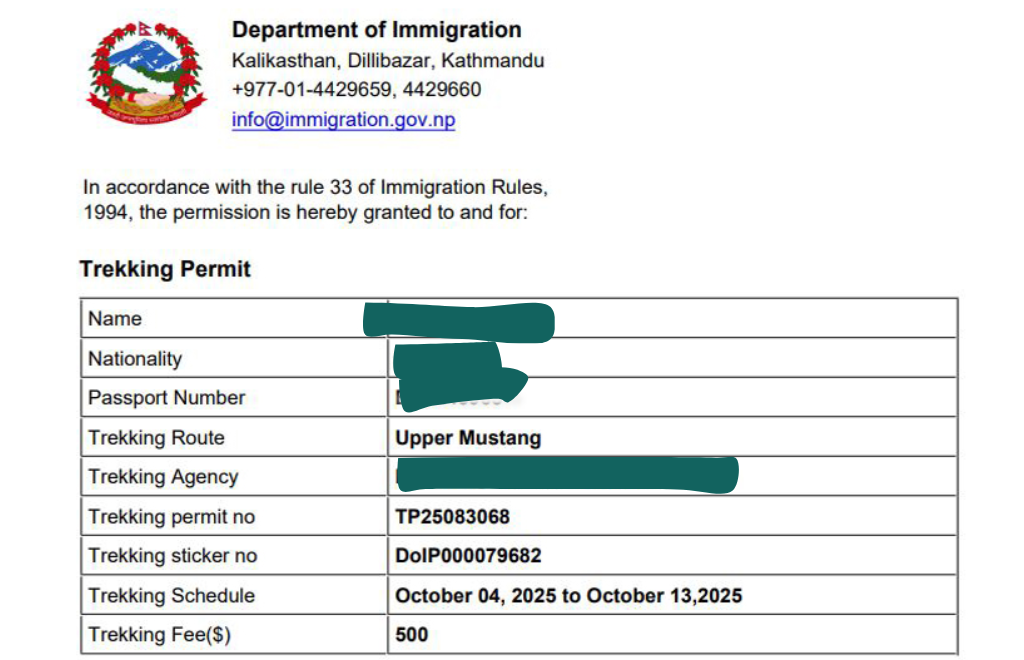
Need to get a restricted area permit? Whether you are heading to the "Forbidden Kingdom" of Upper Mustang or the rugged circuit of Manaslu, we provide the legal certification, licensed guides, and digital permit processing you need for a 2026 solo adventure. Contact us and Secure Your Solo Permit Today.
What the 2026 Reform Means for Your Trek to Upper Mustang, Manaslu, and Beyond
The March 2026 reform of the restricted area trekking permit in Nepal marks a new era in responsible adventure tourism. By removing the minimum group-size requirement while reinforcing safety regulations, authorities have created a modernized permit system that reflects evolving travel patterns and operational realities. For trekkers, the reform offers greater flexibility. For agencies, it introduces new responsibilities. For Nepal’s tourism industry, it signals the beginning of a new era, one defined by efficiency, transparency, and responsible adventure travel in regions such as:
The trekking season is expected to be the first full test of this new system, and industry observers believe it will reshape how travelers explore Nepal’s most remote and culturally significant regions for years to come.
FAQs
1. Can I trek completely alone without a guide?
No. While the "two-person minimum" rule has been abolished, the mandatory guide requirement remains strictly in place. Solo trekkers must be accompanied by a licensed trekking guide from a registered agency at all times in restricted areas.
2. How do I get my permit before I arrive in Nepal?
Under the new 2026 digital system, your trekking agency can start your application using your Visa Application ID or Passport details. This allows the Department of Immigration to pre-approve your permit so it's ready for final verification the moment you land in Kathmandu.
3. Are the permit fees higher for solo travelers?
No, the government permit fees remain the same per person. For example, Upper Mustang is still $50 per person per day. However, as a solo traveler, you will bear the full cost of your guide's salary, insurance, and logistics, which were previously split between group members.
4. Can I change my itinerary once the permit is issued?
Restricted Area Permits are issued for specific dates and routes. The 2026 digital system tracks entries at checkpoints more strictly. If you wish to change your route, your agency must update the digital record with the Department of Immigration, which may incur additional fees.
5. What happens if I get sick and I'm trekking solo?
This is why the 2026 reform requires the issuing agency to take full legal and financial responsibility for rescues. If you are solo, your guide will coordinate directly with the agency’s Kathmandu office to trigger an immediate satellite-coordinated evacuation if necessary.

.webp)

.webp)