Tucked away in the rain shadow of the mighty Annapurna and Dhaulagiri massifs lies a landscape unlike any other in Nepal. Upper Mustang, the ancient Forbidden Kingdom of Lo, offers an extraordinary journey into a trans-Himalayan desert characterized by towering red fluted cliffs, deeply eroded canyons, and prehistoric sky caves. Historically isolated from the outside world until opening to trekkers in 1992, this unique region preserves an intact, centuries-old Tibetan Buddhist culture that has remained virtually untouched by modern transformations.
For modern adventurers, the primary challenge of planning a journey to this restricted area is choosing the right itinerary. The choice between a 15-day Upper Mustang trek and an 18-day Upper Mustang trek determines more than just your calendar dates; it shapes the physical pace of your journey, the depth of your cultural immersion, and your ability to venture off the beaten path into remote eastern valleys. Choosing an efficient, fast-paced out-and-back route allows you to see the main highlights on a tighter schedule. Conversely, selecting an extended circuit reveals hidden cave monasteries and offers a more gradual high-altitude acclimatization profile. To help you select the ideal package, this definitive guide provides a day-by-day comparison of the two itineraries, explains the unique logistics of restricted-area trekking, and outlines the practical realities of exploring this ancient Himalayan landscape.
Table of Contents
The Geography of Mustang Region
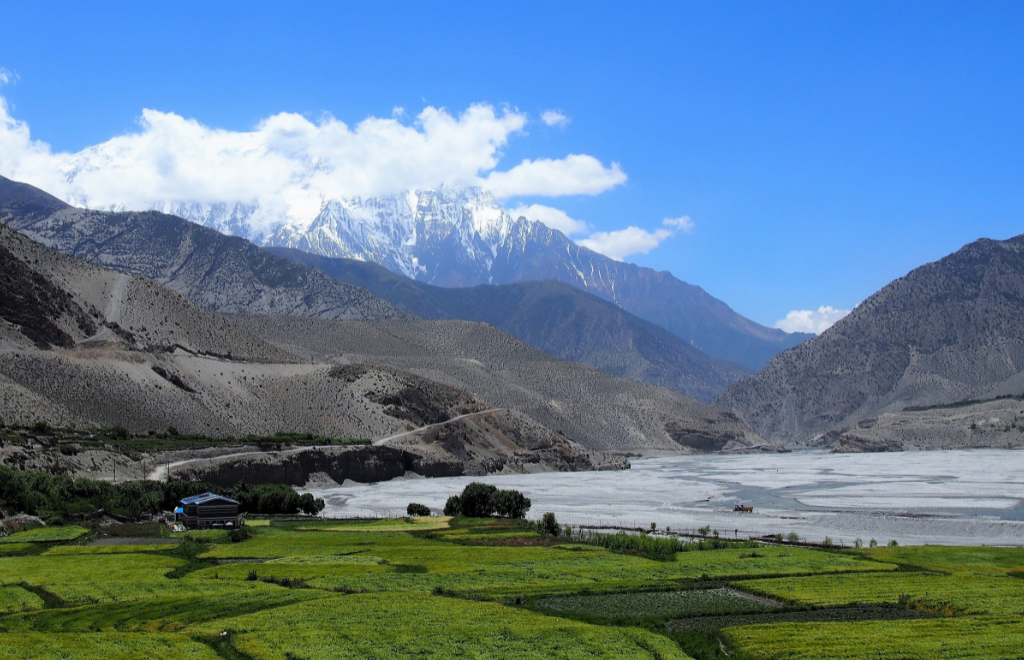
Kaligandaki, Mustang
To appreciate the design of these two itineraries, it helps to understand the distinct geographical and geological characteristics of Upper Mustang. This region contrasts sharply with the lush, green valleys typically associated with trekking in Nepal.
The Rain Shadow Effect & Summer Trekking
Upper Mustang sits directly north of the massive Himalayan barrier formed by Annapurna and Dhaulagiri. These peaks block the moisture-laden clouds traveling north from the Bay of Bengal, creating a classic rain shadow effect. While most regions of Nepal experience heavy downpours, muddy trails, and obscured mountain views during the summer monsoon season (June to August), Upper Mustang remains dry, arid, and highly crossable. It stands out as an exceptional choice for travelers seeking high-altitude trekking in Nepal during the summer months.
Canyons, Cliffs, and Red Fluted Rocks
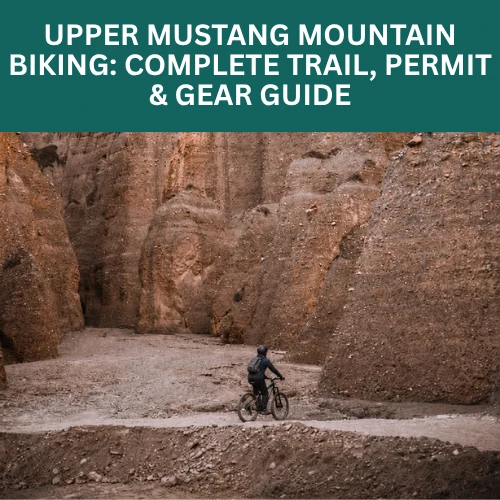
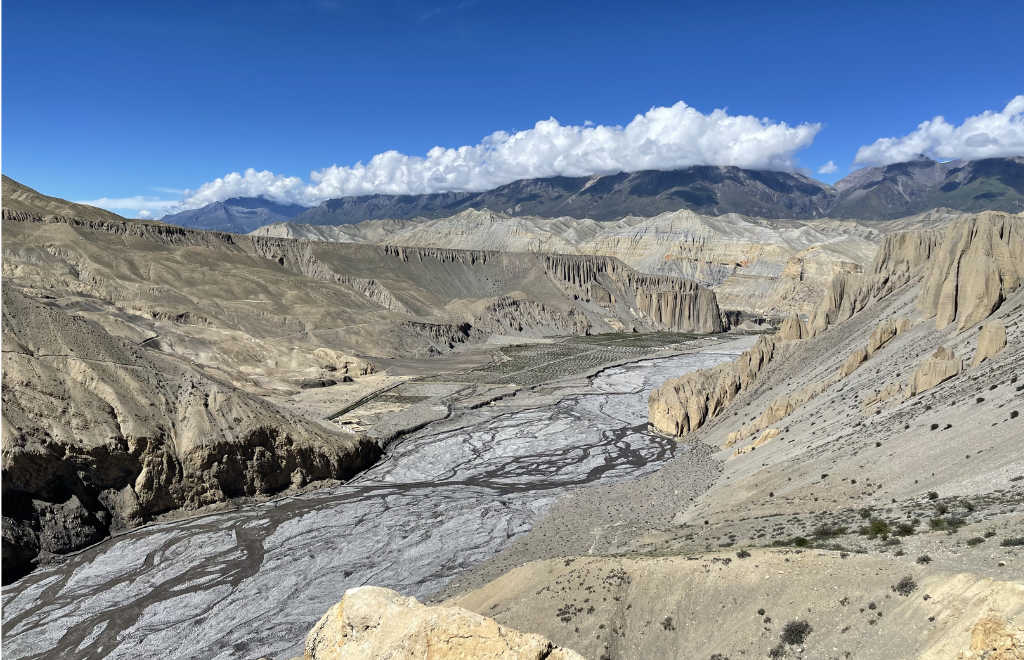
The terrain of the trans-Himalayan desert features wind-carved architecture, massive labyrinthine canyons, and dramatic red cliffs molded by centuries of intense wind erosion. The elements have sculpted spectacular fluted columns into the mountainsides, which glow in shades of ochre, amber, and deep crimson. Trekking here requires navigating distinct daily wind patterns: every afternoon, powerful gales rush northward through the Kali Gandaki Gorge, stirring up dust and requiring proper eye and face protection.
Altitude Profile and Acclimatization for Upper Mustang
The trek begins in Jomsom at an elevation of 2,720 meters. From there, the trail climbs steadily across the cold desert landscape, crossing numerous high passes that exceed 3,800 to 4,000 meters. While Upper Mustang does not reach the extreme elevations of the Everest Base Camp or Cho La Pass routes, its challenges stem from consecutive days spent above 3,500 meters, dry air, and steep descents into deep riverbeds. Managing your ascent rate and planning proper acclimatization stops are essential safety measures for both itineraries.
Must-See Attractions in Upper Mustang Region
Before comparing schedules, let us look at the primary cultural and historical landmarks that make this restricted area trekking experience unique.
The Walled City of Lo Manthang
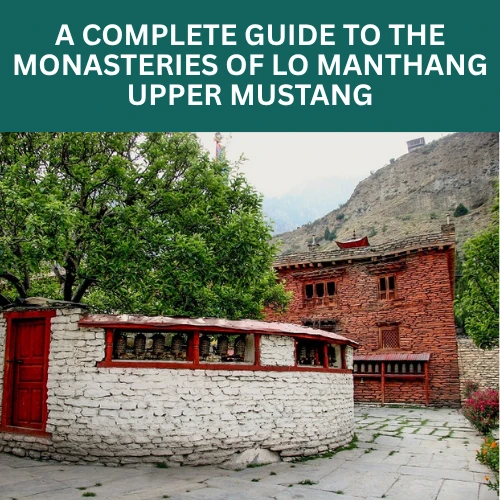
The ultimate destination of any Upper Mustang itinerary is Lo Manthang, the capital of the former Kingdom of Lo. Founded in the 15th century and enclosed by an imposing 6-meter-tall earthen wall, this medieval settlement feels like a living museum. Inside the maze-like alleyways stands the four-story Royal Palace, along with three meticulously restored historic monasteries: Thubchen Gompa, Jampa Gompa, and Choodey Gompa. These structures house brilliant, centuries-old Buddhist frescoes, massive clay statues, and rare illuminated manuscripts cared for by local monks.
Chhoser Caves (Shija Jhong)
Located a short distance north of Lo Manthang toward the Tibetan border, the Chhoser cave complex features remarkable cliffside architecture. The multi-story Shija Jhong Cave is carved directly into a vertical rock face and contains over 40 distinct rooms connected by ladders and narrow passages. Archaeologists believe these human-made cave systems served alternately as defensive fortresses, burial sites, or meditation chambers dating back thousands of years.
Ghar Gompa (Lo Gekar)
Perched on a quiet hillside along the western route, Ghar Gompa, also known as Lo Gekar, is widely considered one of the oldest active Tibetan Buddhist monasteries. Historical accounts link its founding to the 8th-century master Guru Rinpoche, who built it to pacify local spirits before constructing Samye Monastery in Tibet. The interior features painted woodcarvings, ancient stone plaques, and a peaceful atmosphere filled with prayer wheels.
The Red Cliffs of Dhakmar
The village of Dhakmar sits beneath some of the most striking geological formations in the entire region. According to local mythology, these towering red cliffs were stained by the blood of a demon vanquished by Guru Rinpoche. For photographers and travelers, the sheer scale of the crimson rock faces contrasted against bright green fields of buckwheat below creates a stunning visual memory.
Want to know more about this topic? Read our full blog below for a complete guide.
The 15-Day Upper Mustang Itinerary: The Efficient Route
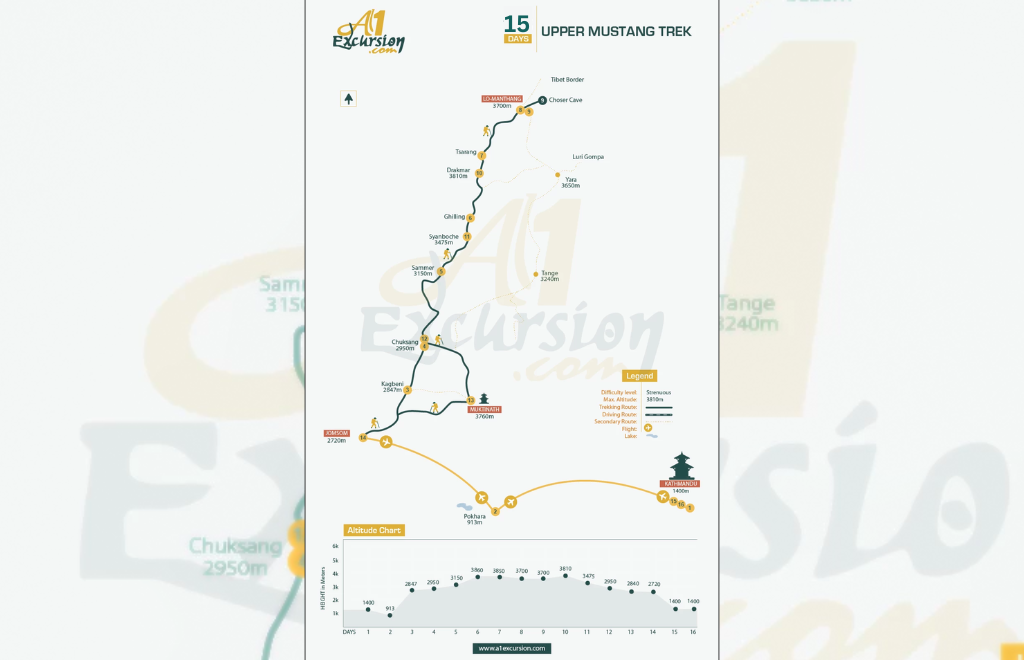
Route-Map Upper Mustang Trek Itinerary 15-Days
The 15-day Upper Mustang trek is a classic, direct route designed to maximize your time. It follows an efficient path northward along the western banks of the Kali Gandaki River directly to Lo Manthang, before looping slightly west on the return leg to showcase Dhakmar. This option is well-suited for fit trekkers with limited time who want to experience the core highlights of the region without extended stays in the remote eastern valleys.
15-Day Day-by-Day Itinerary Upper Mustang Trek
Day 1: Arrival in Kathmandu – Arrive at Tribhuvan International Airport. Meet your A1 Excursion Adventure representative, transfer to your hotel, and join a pre-trip safety briefing.
Day 2: Drive to Pokhara by Tourist Bus – Travel along the scenic Prithvi Highway, following the Trishuli and Marsyangdi rivers to the lakeside city of Pokhara.
Day 3: Fly from Pokhara to Jomsom & Trek to Kagbeni (2,800m) – Take an early morning flight between the peaks of Annapurna and Dhaulagiri to Jomsom. Begin walking along the windy flats of the Kali Gandaki riverbed to Kagbeni, the historic gateway to Upper Mustang.
Day 4: Trek from Kagbeni to Chele (3,050m) – Present your restricted area permits at the Kagbeni checkpoint. Follow the riverbank past distinct sand tunnels to Tangbe, then cross a suspension bridge to climb steeply up to Chele.
Day 5: Trek from Chele to Geling (3,570m) – Ascend via the Taklam La Pass (3,624m) and Dajori La Pass (3,735m), taking in views of isolated settlements and deep canyons. Descend gradually into the village of Geling.
Day 6: Trek from Geling to Tsarang (3,560m) – Climb over the scenic Nyi La Pass (4,010m) and the Ghemi La Pass (3,765m). Pass Nepal's longest ancient mani wall—a stone structure inscribed with Buddhist prayers—before reaching Tsarang, home to a massive white monastery and fortress.
Day 7: Trek from Tsarang to Lo Manthang (3,810m) – Descend into the Tsarang Chu canyon, cross the river, and climb steadily up to the Lo La Pass (3,950m). From the crest, catch your first clear look at the walled city of Lo Manthang.
Day 8: Explore Lo Manthang & Surrounding Highlights – Spend the day visiting the historic monasteries within the city walls. Arrange a short horse or jeep excursion to the Chhoser cave complex and Shija Jhong Cave.
Day 9: Trek from Lo Manthang to Dhakmar (3,820m) via Ghar Gompa – Follow the western return trail across the ridge line. Stop to visit the ancient Lo Gekar (Ghar Gompa) before dropping down among the vivid crimson cliffs of Dhakmar.
Day 10: Trek from Dhakmar to Syangbochen (3,800m) – Set out early to avoid the strong midday winds. Walk past traditional stone villages, agricultural fields, and high pastures to return to Syangbochen.
Day 11: Trek from Syangbochen to Chhuksang (2,980m) – Trace your steps back down through the canyon systems, crossing high points with wide views of the Nilgiri and Annapurna ranges before resting in Chhuksang.
Day 12: Trek from Chhuksang to Jomsom (2,720m) – Walk the final stretch along the river flats back to Jomsom, closing out the loop and enjoying a hot meal to celebrate the trek.
Day 13: Fly back to Pokhara – Board an early morning flight back to Pokhara. Spend a relaxing afternoon by the lakeside or exploring the city.
Day 14: Drive back to Kathmandu – Return to the capital by tourist bus, check into your hotel, and enjoy a farewell dinner.
Day 15: Final Departure – Transfer to the airport for your international flight home.
Who Should Choose the 15-Day Itinerary for Upper Mustang?
This route is ideal for active, physically fit trekkers who face fixed holiday schedules but still want to see Lo Manthang. Because it returns south along a similar path, it requires longer daily walking hours and offers less time for spontaneous sidetrips. It provides an efficient, well-structured introduction to the region.
The 18-Day Upper Mustang Itinerary: The Immersive Route
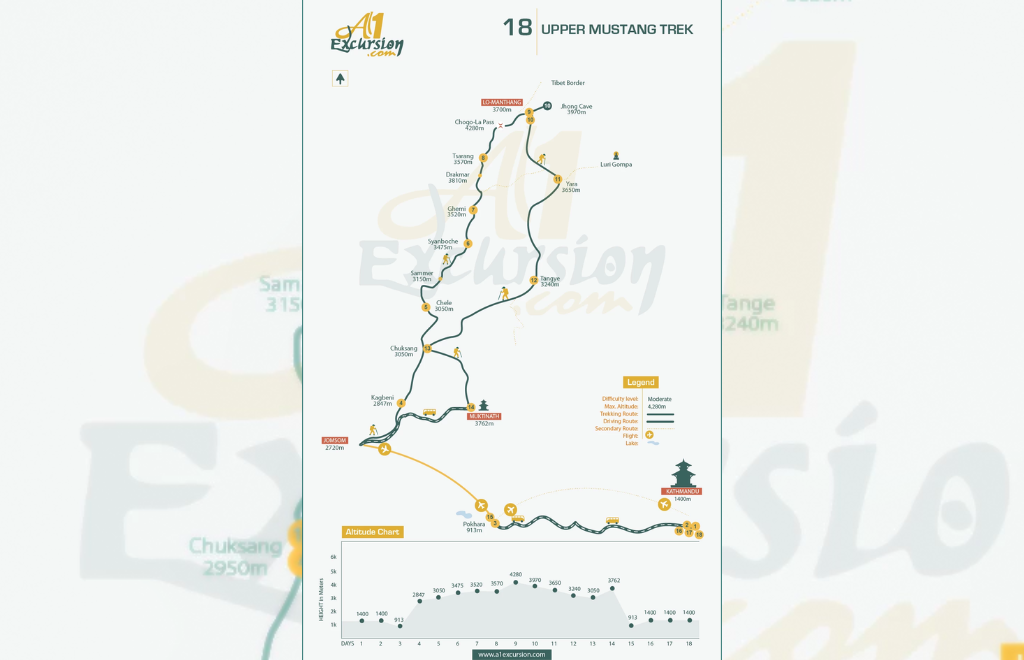
Route-Map Upper Mustang Trek Itinerary 18-Days
For travelers seeking a complete circle through the region, the 18-day Upper Mustang trek offers an immersive alternative. This route expands upon the classic journey by turning east after visiting Lo Manthang.
It takes you through the remote, rarely visited eastern valleys of Yara and Tangye, crossing the challenging Chogo-La Pass (4,280m). This itinerary avoids backtracking almost entirely, exposing you to traditional village life, basic teahouses, and pristine landscapes.
Day 1: Arrive in Kathmandu – Warm welcome at the airport, transfer to your hotel, and initial trip orientation.
Day 2: Sightseeing & Trek Preparation – Enjoy a guided tour of Kathmandu’s UNESCO World Heritage sites while our team secures your restricted area permits from the Department of Immigration.
Day 3: Drive to Pokhara – Scenic overland journey to Pokhara. Rest and prepare your gear by the lake.
Day 4: Fly to Jomsom & Trek to Kagbeni (2,800m) – Morning flight into the mountains, followed by a light introduction walk to Kagbeni.
Day 5: Trek to Chele (3,050m) – Enter the restricted area checkpoint and follow the river corridor to Chele.
Day 6: Trek to Syangbochen (3,800m) – Climb past the canyon passes to reach Syangbochen, allowing for a steady, well-paced acclimatization profile.
Day 7: Trek to Ghemi (3,520m) – Walk over the Yamada La (3,860m) and Nyi La (4,010m) passes, descending into Ghemi, a village surrounded by terraced fields.
Day 8: Trek to Tsarang (3,560m) – Cross the Ghemi Khola and walk along an ancient mani wall before climbing toward Tsarang.
Day 9: Trek to Lo Manthang via Chogo-La Pass (4,280m) – Opt for the higher, scenic western trail over the Chogo-La Pass, the highest point of the journey, before descending into the walled capital.
Day 10: Explore Lo Manthang & Jhong Caves – Spend a dedicated day visiting the historic town monuments and taking an excursion to the multi-story Chhoser cave complex.
Day 11: Trek to Yara (3,650m) – Leave the main trail behind and head east across the high, windy plateaus. Drop down a steep canyon to cross the Kali Gandaki River, entering the remote settlement of Yara.
Day 12: Exploration Day: Visit Luri Gumba (3,900m) & Tangye Trail – Hike up to the remarkable 14th-century Luri Gumba cave monastery, a premier highlight of eastern Mustang.
Day 13: Trek from Yara to Tangye (3,240m) – Embark on a long, remote day of wilderness walking across barren high-altitude pastures, followed by a steep descent into the traditional village of Tangye.
Day 14: Trek from Tangye to Chhuksang (2,980m) – Complete a challenging, rewarding day over the Pa Pass (4,210m) before descending to the riverbed village of Chhuksang.
Day 15: Trek to Muktinath (3,760m) – Leave the classic Mustang loop to ascend toward the sacred pilgrimage site of Muktinath, a shrine revered by both Hindus and Buddhists.
Day 16: Drive to Jomsom & Fly to Pokhara – Take a short morning drive down to Jomsom, then catch your flight back to Pokhara for a relaxing afternoon.
Day 17: Fly from Pokhara back to Kathmandu – A quick morning flight offers final aerial views of the Annapurna range. Spend your last afternoon shopping or exploring Kathmandu.
Day 18: Final Departure – Departure transfer to the airport for your return flight.
Exclusive Feature: Luri Gumba
The stand-out destination of the 18-day eastern circuit is Luri Gumba, a 14th-century cave monastery perched on a fluted mud cliff near Yara. Unlike the town monasteries of Lo Manthang, Luri Gumba is carved directly into the heart of a high rock column. Inside the main chamber stands a beautifully preserved mud-brick stupa covered in delicate, old frescoes that show significant Newari and Indian artistic influences. This site is rarely crowded, offering a quiet look into the region's spiritual heritage.
Trail Reality Check: The Eastern Circuit
Venturing into the eastern sector on the 18-day itinerary introduces a more rugged trekking experience. The teahouses in Yara and Tangye are simple, family-run homes with basic amenities. Meals consist of traditional, hearty mountain food like dal bhat (lentil soup and rice), noodle soups, and local barley porridge. The trails here are less defined, the wind can be intense, and water sources are far apart, making it a true backcountry experience.
Who Should Choose the 18-Day Itinerary or Upper Mustang?
This option is custom-made for photographers, cultural enthusiasts, and seasoned trekkers who want an immersive experience. The extended timeline ensures a comfortable pace for acclimatization, cuts down on backtracking, and allows you to explore remote eastern valleys like Yara and Tangye.
Head-to-Head Comparison — 15 Days vs 18 Days Upper Mustang Trek
To help you choose between these two travel strategies, here is a breakdown of their primary differences: 15 Days vs 18 Days Upper Mustang Trek.
Itinerary Comparison Summary
Category
15-Day Efficient Itinerary
18-Day Immersive Itinerary
Max Walking Altitude
4,010 meters (Nyi La Pass)
4,280 meters (Chogo-La Pass)
Days in Restricted Zone
9 Days
11 Days
Permit Fee Cost
$500 USD minimum per person
$600 USD minimum per person
Unique Landmarks
Lo Manthang, Chhoser, Dhakmar
Luri Gumba, Yara, Tangye, Muktinath
Teahouse Infrastructure
Standard, well-established options
Simple, traditional homestays in the eastern valley
Physical Difficulty
Moderate (longer daily walks)
Adventurous, Demanding (remote wilderness stages)
Acclimatization Comfort
Standard progression
Excellent (gradual, multi-pass loop)
Budget Impact
Medium (lower permit and guide fees)
Higher (extended permit days and logistics)
Best For
Trekkers with fixed schedules
Photographers and adventure purists
Permit Cost on the Upper Mustang Trekking
The Department of Immigration manages Upper Mustang as a strictly protected restricted zone. Independent solo trekking is completely prohibited; all travelers must book through a registered Nepalese agency and travel with a licensed guide. The Restricted Area Permit (RAP) carries a mandatory base fee of 50 USD per person per day inside the zone. When you factor in the required Annapurna Conservation Area Project (ACAP) permit, your total permit costs adapt directly to your itinerary: While the 18-day journey carries a higher upfront permit cost, the extra investment buys you access to the untouched eastern valleys and the historic Luri Gumba monastery.
Discover more details and helpful insights in the full blog below.
Acute Mountain Sickness (AMS) on the Upper Mustang Trek
Acute Mountain Sickness (AMS), commonly known as altitude sickness, occurs when your body does not adapt quickly enough to the lower atmospheric pressure and reduced oxygen levels found at high elevations. Above 2,500 meters, anyone can be affected regardless of age or physical fitness. Early symptoms feel remarkably like an alcohol hangover. Cardinal signs include a persistent, throbbing headache, mild nausea, dizziness, fatigue, and difficulty sleeping.
While Upper Mustang does not reach the extreme altitudes of the Everest or Annapurna Circuit regions, the trek takes you completely into a high-altitude desert where you spend consecutive days sleeping above 3,500 meters. The air is exceptionally dry, which accelerates dehydration, a major trigger that predisposes trekkers to altitude illness. If early symptoms are ignored and an ascent continues, mild AMS can progress into life-threatening complications: High Altitude Pulmonary Edema (HAPE, fluid accumulation in the lungs) or High Altitude Cerebral Edema (HACE, swelling of the brain).
Want the full information and expert insights? Read the complete blog below.
Trekking Gear Checklist for Trekking in Upper Mustang
Regardless of which itinerary you select, packing the right gear is essential for the dry, windy, and cold trans-Himalayan climate of Upper Mustang. Be sure to review our blog below on the topic
Nepal Packing List Guide
Wind protection: A high-quality, breathable windproof jacket and pants are necessary for the intense afternoon gales in the Kali Gandaki valley.
Eye and face protection: Bring UV-blocking sunglasses and multi-functional neck gaiters (buffs) to guard against flying dust.
Sleeping gear: A down sleeping bag rated comfort-minimum to $-15^\circ\text{C}$ ensures warm nights in unheated teahouses.
Footwear: Use sturdy, well-broken-in trekking boots with good ankle support, paired with moisture-wicking wool socks.
Hydration: Bring two 1-liter durable water bottles along with water purification tablets or a reliable filtration system.
If you want to know more and explore this topic in detail, read our full blog below.
The Department of Immigration enforces strict safety and conservation guidelines within Upper Mustang:
Minimum Group Size: Permits require a minimum of two registered international trekkers per group.
Guide Mandatory: Solo trekking is not allowed under any circumstances. You must be accompanied by a licensed Nepalese guide.
Checkpoint Compliance: Original passports and permits must be verified at security checkpoints in Kagbeni, Tsarang, and Lo Manthang.
Expert Navigation and Group Care
Our experienced guides manage every step of your journey. We take care of permit verification, secure the best available rooms in local teahouses, monitor weather conditions, and provide daily health and altitude checks. Responsible Tourism and Local Impact. We are committed to fair-pay practices for our guides and porters, and we choose locally-owned teahouses to ensure your visit directly supports the communities of Mustang. Our teams follow Leave No Trace principles to preserve this fragile trans-Himalayan ecosystem for generations to come.
Upper Mustang Trek Packages by A1 Excursion Adventure
At A1 Excursion Adventure, we organize tailor-made itineraries managed by professional local guides. We offer several curated travel options depending on your timeline and preferences:
The choice between an Upper Mustang trek 15 days vs 18 days comes down to your available time and travel goals. If you are on a fixed schedule and want to see the primary highlights efficiently, the 15-day itinerary Short Upper Mustang Trek delivers a classic, well-structured experience. If you prefer a complete circle route that explores the remote eastern valleys, includes the historic Luri Gumba cave monastery, and offers extra time for natural altitude adaptation, the 18-day Classic Upper Mustang Trek is a premier choice.
What is the Upper Mustang trek difficulty level compared to other regions?
The Upper Mustang trek is generally classified as moderate to demanding. It features fewer steep, relentless steps than the Annapurna Sanctuary or Everest Base Camp routes. However, its challenges come from consecutive days of walking in dry, dusty, and windy conditions at altitudes ranging from 3,000 to 4,280 meters. The trail requires good cardiovascular fitness and a pair of well-broken-in hiking boots.
How much is the Lo Manthang entry permit cost under the daily tracking rules?
The Restricted Area Permit (RAP) costs a flat fee of $50 USD per person per day in the restricted zone. You must also purchase an Annapurna Conservation Area Project (ACAP) entry permit, which costs approximately 3,000 NPR (around $23 USD).
Are the Upper Mustang solo trek rules strictly enforced?
Yes, the immigration rules are strictly enforced at multiple government checkpoints throughout the route, starting at Kagbeni. Solo independent trekking is entirely prohibited. You must travel with at least two people in your permit group and be accompanied by a licensed guide from an authorized Nepalese trekking company.
What is the real Jomsom to Lo Manthang distance on foot?
The total walking distance from Jomsom to Lo Manthang along the classic western trekking route is approximately 55 kilometers (34 miles). A complete 18-day loop that includes the eastern villages of Yara and Tangye increases the total foot distance to around 110 to 120 kilometers.
Jeep vs Trekking: Which option offers the better Upper Mustang experience?
Trekking on foot provides the most complete experience, allowing you to walk ancient trade trails, cross high passes at a natural pace, and fully experience the local culture. If you face physical limitations or time constraints, a 4WD jeep tour offers a faster, less strenuous alternative that still lets you visit the main historic sites of Lo Manthang.
Raj Thapa
Founder & Managing Director Raj Kumar Thapa: Founder & Managing Director of the Company, and has over 2 decades of professional experience in the travel and trekking field. Mr. Raj has spent the entirety of his career in the travel & trek organization.


.webp)